


There’s a certain kind of post that doesn’t stop you because it’s clever, but because it quietly exposes something you’ve already circled—without quite naming.
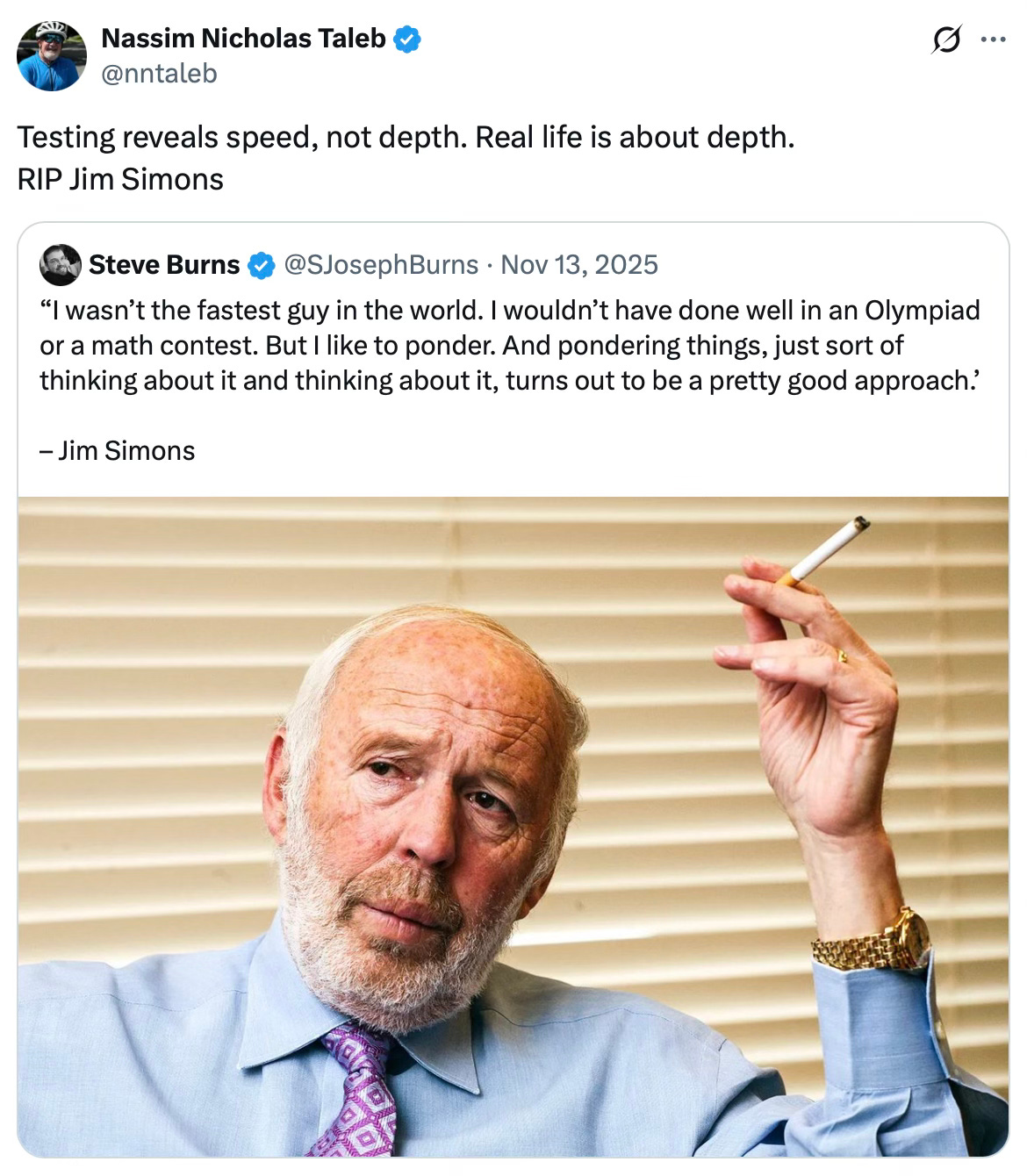
I ran into one of those moments recently while scrolling X. It came from Nassim Nicholas Taleb, who wrote:
I don’t always agree with Taleb.
But I almost always respect him.
Not because he’s right all the time—he isn’t—but because he insists on grounding arguments in probability, exposure, and consequence. He doesn’t let intuition float freely. He demands it survive contact with math, with risk, with downside.
Still, that line stuck—not as a conclusion, but as a lens. And once it did, it began illuminating things I had already written… without fully seeing.
Speed, Testing, and the Comfort of Metrics

Modern life is obsessed with tests.
Timed exams.
Rapid-fire interviews.
Rankings.
Leaderboards.
Engagement metrics.
They all answer the same question: How fast can you respond under artificial constraints?
Speed matters. Sometimes enormously. But speed is a narrow signal. It tells us who can surface answers quickly—not who understands the structure of the problem, or whether the answer will hold once conditions change.
I’ve bumped into this distinction before. In The Game I Couldn’t Play, the entire system selected for velocity. If you weren’t fast enough, you simply didn’t belong in the game. Insight didn’t matter. Patience didn’t matter. Only reaction time.
That’s when it became clear:
some environments reward speed because speed is the point.
Real life usually isn’t one of them.
Jim Simons, Revisited

This is where the timeline matters.
18 months ago, I wrote about Jim Simons—his brilliance, his secrecy, the almost absurd success of Renaissance Technologies. It was a piece about depth, even if I didn’t quite call it that at the time.
What I missed was the unifying thread.
“I wasn’t the fastest guy in the world… But I like to ponder.”
That line wasn’t new.
But my understanding of it was.
Seen on its own, it reads like a personality aside. A humanizing detail. But placed next to Taleb’s observation about testing and real life, it becomes explanatory.
Simons didn’t win by reacting faster.
He won by staying with problems longer.
The pondering wasn’t incidental.
It was the method.
Taleb’s post didn’t introduce a new idea—it revealed the one I had already written around without naming. The depth was there all along. I just hadn’t articulated what powered it.
What This Has to Do with Seed Scapes

This is, quietly, what Seed Scapes has always been about.
Not answers.
Not speed.
Not being first.
Pondering.
Sometimes that means connecting dots looking backward—realizing what mattered only after enough time has passed. Other times it means seeing a familiar idea refracted through someone else’s lens and recognizing the missing thread.
Depth doesn’t always announce itself in real time.
Often, it reveals itself later—when something unexpected forces a second look.
Speed performs well on tests.
Depth survives contact with reality.
And most of the people who quietly change things aren’t rushing. They’re sitting with problems longer than the world thinks is reasonable.
🌱 Seed Thought: Speed proves you can answer. Depth proves you understand. And understanding often arrives late—if you’re patient enough to let it.

I really appreciate it. But I’d love if you could also subscribe to my newsletters so we can read and support each other’s posts too. Thank you!