


A couple of weeks ago, in Somebody Bring a Grinding Wheel, I included this little diagram of the political horseshoe.
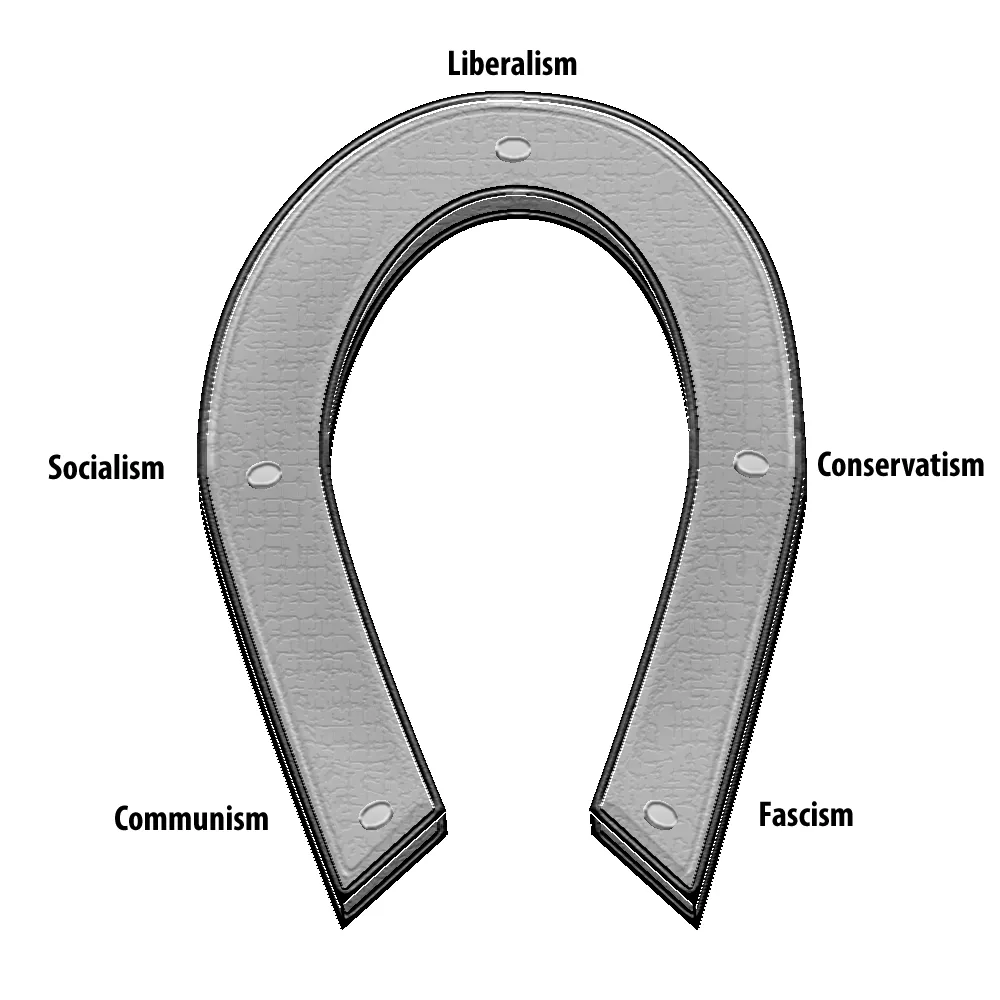
The idea is simple. Instead of imagining politics as a straight line—with communism disappearing infinitely far to the left and fascism infinitely far to the right—the ends curve back toward one another.
I was careful then, and I’ll be careful again now: the horseshoe isn’t a map. It’s a warning.
The ends don’t actually meet. Communism and fascism aren’t the same thing, any more than liberalism and conservatism are secretly marching toward the same destination.
But there’s something interesting about the shape.
As the ends move closer together, they begin to look increasingly alike. Their beliefs may remain worlds apart, but their methods can become remarkably similar. Suppression of dissent. Concentration of power. The conviction that the righteousness of the cause justifies almost anything done in its name.
Stand close enough, and the differences are obvious. Stand far enough away, and it becomes difficult to tell which end you’re looking at.
That’s the power of the analogy. And perhaps its warning.
Sometimes you have to step far enough away from what you believe to recognize what you’re actually doing.
A Very Short History Lesson That Isn’t One
Then I saw a Babylon Bee video that made me laugh.

And think.
The premise is wonderful.
A progressive time traveler goes back to 1933 to kill Hitler. Before she pulls the trigger, Hitler asks the obvious question: Why?
She begins explaining.
She wants government power to force good ideas on people. Hitler perks up.
She wants dangerous ideas silenced. More enthusiasm.
Certain undesirable groups are standing in the way of utopia. Now things are getting uncomfortable.
Segregation. Gun control. Eugenics. Socialized healthcare. One similarity after another appears until our increasingly confused time traveler discovers that, horror of horrors, they’re both vegetarians.
It’s satire. It cheats.
Of course it does.
The sketch compresses history, strips away context, chooses convenient comparisons, and ignores inconvenient differences. Please don’t use The Babylon Bee to study for your European history final.
But that’s also what makes an analogy an analogy.
If two things had to be identical before we were allowed to compare them, we wouldn’t need analogies. We’d just call them the same thing.
The useful question isn’t whether today’s progressive left is secretly Nazi Germany. It isn’t. Nor is the useful question whether today’s populist right is secretly Nazi Germany. It isn’t either.
The progressive time traveler isn’t Hitler. The joke works because she doesn’t recognize how much some of her proposed methods resemble his. She’s so focused on the differences between their intentions that she cannot see the similarities in their behavior.
That’s what makes the horseshoe interesting.
You don’t have to become the thing you oppose to begin behaving like it.
And the closer you get to the ends, the harder that can be to see from where you’re standing.
Most of Us Aren’t at the Ends

There is something else worth remembering whenever we talk about political extremes.
Most of us aren’t there.
Most Americans can have very strong opinions about taxes, immigration, abortion, guns, healthcare, climate change, education, or almost anything else without wanting to imprison the people who disagree with them.
We have somehow built a political culture that makes the loudest people at the ends appear much larger than they really are.
Social media certainly helps.
Outrage travels better than nuance. Certainty gets more engagement than doubt. “Those people are evil” fits neatly into a post. “I think they’re wrong about this but may have a point about that” isn’t exactly algorithmic rocket fuel.
Maybe that explains at least some of the curiosity around Andrew Yang’s Forward Party.
I have no idea whether Forward ultimately becomes anything important. Third parties in America have a long history of becoming trivia questions. But it is managing to put candidates on ballots, attract elected officials, and generate at least a little evidence that “none of the above” is becoming a political constituency of its own.
That interests me.
Not because the answer to every political disagreement must lie halfway between Democrats and Republicans. I wrote that last time too. Sometimes the left is right. Sometimes the right is right. Sometimes they’re both wrong.
The interesting part is the exhaustion.
Maybe a growing number of people aren’t looking for the midpoint.
Maybe they’re just looking for a place where disagreement doesn’t require hatred.
The Common Denominator

That brings me to a line I remembered as coming from Tim Ferriss.
It turns out Tim has repeated a version of it on his podcast, although he introduced it as something somebody told him. A sharper version also showed up in Justified:
If you meet an asshole in the morning, you met an asshole. If you meet assholes all day, you’re the asshole.
That’s useful advice far beyond politics.
If every institution you encounter is corrupt…
If every news source that disagrees with you is propaganda…
If every judge who rules against your side is compromised…
If every election you lose was illegitimate…
If everyone who votes differently from you is stupid, evil, brainwashed, racist, fascist, communist, Marxist, authoritarian, or some other word whose definition becomes less important with each use…
Maybe stop for a second.
Not because you’re necessarily wrong.
Maybe some of those people really are assholes.
But eventually it is worth checking the common denominator.
The horseshoe offers an interesting way to do that. Don’t just look left or right to see how far you’ve traveled. Step back far enough to see the whole thing.
You might discover that the people you disagree with are still very different from you.
You might also discover that, from a distance, you’re beginning to look a little too much alike.
Stay safe out there.
🌱 Seed Thought: Sometimes you have to step far enough away from what you believe to recognize what you’re actually doing.
