


The Morning After
America woke up Wednesday morning to a Blue Wave. The midterm elections had delivered a message, though exactly what that message means will be debated for months, probably years. Winners will claim mandates. Losers will search for explanations. Political analysts will explain why everything that happened was obvious, preferably without mentioning what they predicted the day before.
I’m not interested in writing another election analysis. There will be plenty of those, most written by people who are far more certain about what happened than I am.
I have some observations. A little hope. Maybe a prayer.
And a story about a locked box.
Before the election, someone I know was trying to surrender a set of New Jersey license plates. Did you know you’re supposed to do that when you move out of state and register your vehicle somewhere else? Apparently, failing to properly close out the old registration and insurance can eventually put your driving privileges at risk. Even in a state where you no longer have a car registered.
Good luck finding all the relevant details on the New Jersey MVC website.
Anyway, it was Sunday. The plan was simple. Drive to the MVC office, drop the plates into the collection box outside, and go home. Like returning a library book after hours.
Except the box was locked.
Okay. Annoying, but perhaps they only want people dropping off plates during business hours. Back on Monday, then.
Monday arrived, along with the usual zoo of cars and people trying to get into the MVC office. No problem. Double-park for a moment, run over to the box, drop the plates, and leave.
Still fucking locked.
Inside, in something of a hurry, came the obvious question: What the fuck is wrong with the plate-return box?
The answer?
“Yeah, we know there’s something wrong with the box.”
That’s it.
Maybe Larry got fired and took the key with him. Maybe the lock broke. Maybe there’s an elaborate chain of command governing the maintenance of state-owned license-plate receptacles.
I don’t know.
But there is a lock on a box. Surely somebody could show up with a grinding wheel, cut the thing open, replace the lock, and get on with life.
And that’s when I remembered an article I’d read in The Free Press.
Sometimes, You Can Just Do Things

Jacob Savage wrote a piece called Why Blue States Can’t Have Nice Things. The title is provocative, but the story is better than the politics.
Savage visited Wheeler Farm in Utah with his children. It’s a public facility, operated by Salt Lake County, where admission is free. Kids can interact with farm animals, climb on old tractors, and enjoy the place without their parents needing to take out a second mortgage. Uncrustables were $2. Popsicles were $1.50.
During the visit, a child was injured by a loose plank in a play structure.
The employees cleared the children out, found a nail gun, and fixed the plank.
Imagine that.
Savage later visited the Los Angeles Zoo. Admission for a family of four was $98. Exhibits were closed. Concession stands were boarded up. The petting animals were no longer available for petting. A burger could cost $16, and feeding the family cost him another $75.
The contrast wasn’t simply about money. It was about the difference between a place where people take responsibility for making things work and one where responsibility seems to have become somebody else’s problem.
Savage’s deeper point wasn’t that government employees are incapable or that every regulation is unnecessary. It was that we’ve created systems in which following the process can become more important than solving the problem.
He puts it beautifully: “The red tape isn’t the cause; it’s the excuse.”
Now, I don’t believe this is exclusively a blue-state problem. I’ve seen enough organizations, public and private, to know that bureaucracy is an equal-opportunity disease. A private business can become every bit as dysfunctional as a government agency. Sometimes more so.
And there are perfectly legitimate reasons for safety procedures, liability protections, and maintenance standards. Nobody wants a zoo employee improvising repairs to a tiger enclosure with a nail gun.
But there is a difference between a process designed to help people solve problems and a process designed to protect people from being responsible for solving them.
One produces results. The other produces paperwork.
The broken plank gets fixed.
The license-plate box stays locked.
The Horseshoe
For most of my life, I thought about politics the way most people do. A straight line. Liberalism on the left, conservatism on the right, and various degrees of political conviction stretching toward the extremes.
Then I saw a graphic illustrating horseshoe theory.
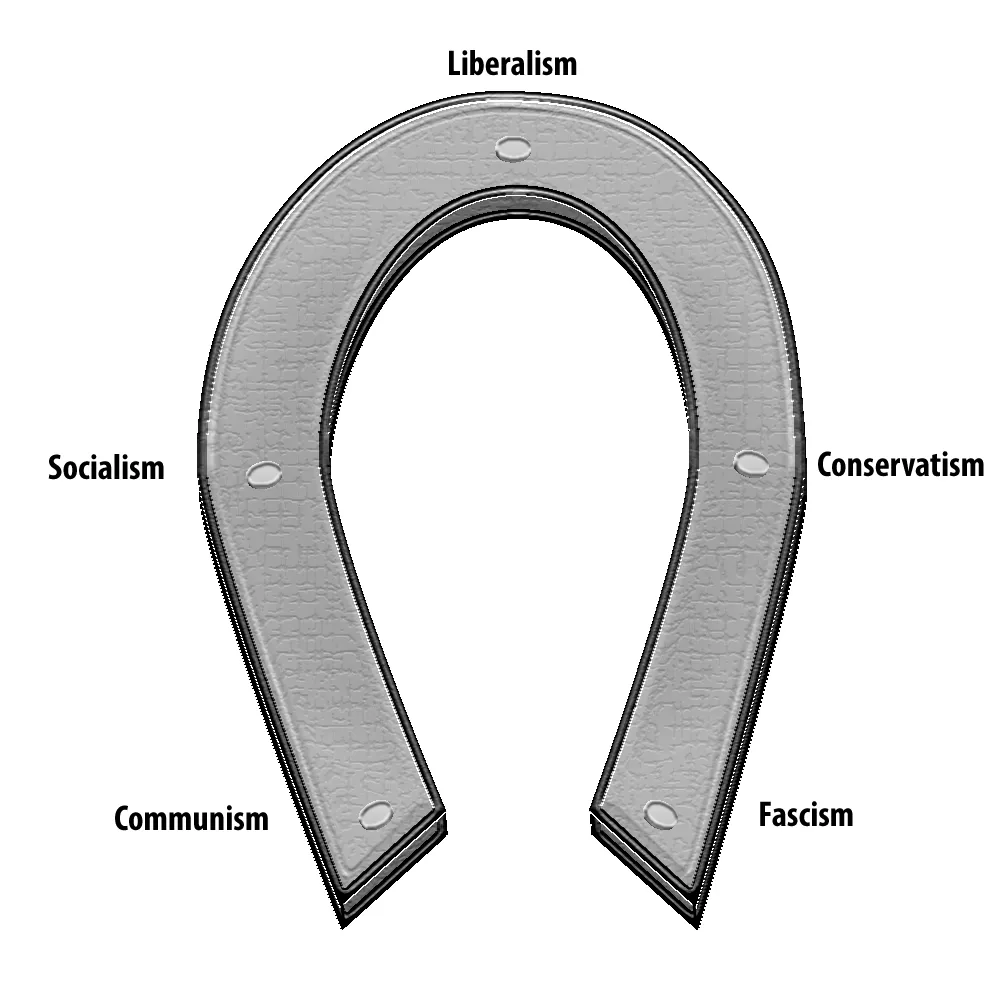
It’s not a perfect model. There are plenty of versions, and political scientists have good reasons to challenge it. Fascism and communism aren’t interchangeable, and political movements have more dimensions than any single diagram can capture.
But the straight line isn’t a particularly good model either.
What struck me wasn’t that the extremes necessarily believe the same things. They don’t. It was the possibility that movements arriving from completely different directions can begin to resemble one another in how they exercise power.
At some point, the objective becomes so important that almost anything can be justified in pursuit of it. Individual liberty, dissent, economic reality, even inconvenient facts can become obstacles to be managed rather than constraints to be respected.
The horseshoe isn’t a map. It’s a warning.
And I worry about the direction of the country, regardless of which side happens to be winning.
Right now, the blue side seems to be telling a more compelling story. The election results certainly suggest that its message resonated with voters, though whether people were voting for that message or against the alternative is another question entirely.
The red side helped create the conditions for that result. It had its opportunity to demonstrate what its promises could accomplish, and enough voters were dissatisfied to change direction.
But there’s something else going on that bothers me more than the election.
We’re becoming very good at telling people whom to blame.
And remarkably bad at explaining how to make things better.
Consider California’s proposed billionaire wealth tax.
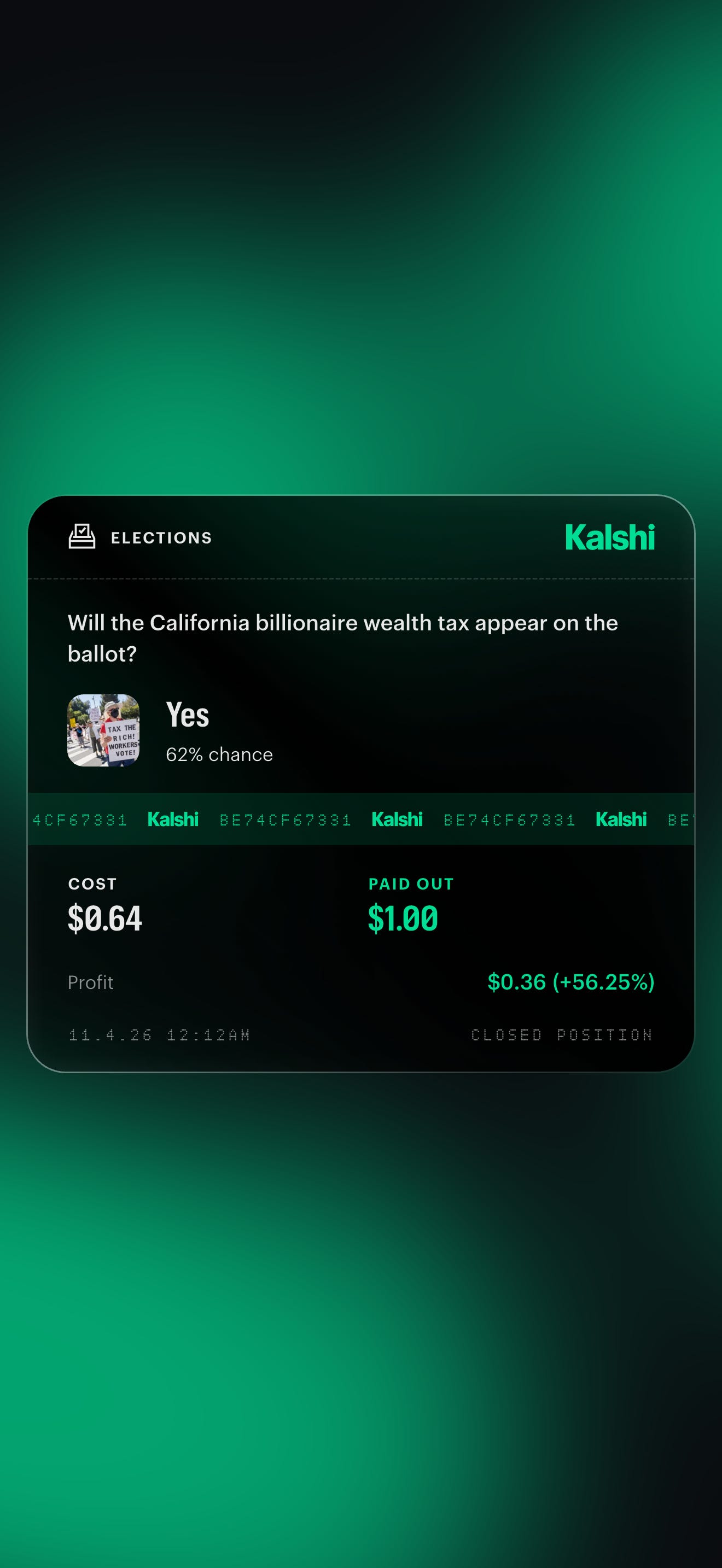
Before the election, I made a small bet on Kalshi that the proposed tax would qualify for the November ballot. Not that it would pass. Not that it was good policy. Simply that enough support could be assembled to put the question before voters.
The bet paid. A 56.25% return.
The attraction of the proposal isn’t difficult to understand. Billionaires have enormous wealth. Governments need money. Why not take a little from those who have so much?
That’s a remarkably easy story to tell.
The competing story involves capital formation, unrealized gains, liquidity, incentives, migration, and the unintended consequences of taxing wealth that may exist primarily as ownership in businesses.
Try fitting that on a bumper sticker.
There are legitimate arguments about how wealth should be taxed and what obligations come with extraordinary financial success. Those deserve serious discussion. But a proposal’s political appeal and its economic consequences are two different questions.
The story can be simple even when the reality isn’t.
And the people most comfortable explaining that reality are often the least comfortable telling a story about it.
The Builders in the Middle
Maybe Andrew Yang is right.
Maybe the way forward requires something outside the familiar red-versus-blue contest. A political middle capable of drawing people who are exhausted by the extremes and more interested in what works than in who gets credit.
But I’m not sure middle is the right word.
Middle sounds like compromise for its own sake. One side wants a tax rate of 20%, the other wants 60%, so we settle on 40% and congratulate ourselves for being reasonable.
That’s not necessarily wisdom. Sometimes one side is right. Sometimes both are wrong. Sometimes the answer isn’t anywhere on the line between them.
The people I’m thinking about aren’t necessarily moderates. Some have strong political convictions. Some are liberal. Some are conservative. Some probably couldn’t tell you the last time they voted in a primary.
They’re builders.
People who start businesses, employ people, develop products, repair equipment, grow food, write software, and figure out how to make things work.
Their ideas eventually encounter something that doesn’t care about political affiliation.
Reality.
A bridge stands or falls. A customer buys or doesn’t. A production line runs or stops. A business makes payroll or it doesn’t.
You can tell whatever story you want about why something should work. Eventually, it has to work.
I’ve spent enough of my life building and operating businesses to appreciate how difficult that can be. I’ve also spent enough time around successful entrepreneurs to know they don’t all agree on much of anything politically.
But they generally understand that a good explanation for failure doesn’t make the failure disappear.
And perhaps that’s the story we’ve forgotten how to tell.
The builders are often too busy building their own stories to explain the larger one. They’re good at solving the problem in front of them, not necessarily at translating that experience into something millions of people can understand.
Meanwhile, political movements have become exceptionally good at identifying villains.
The rich. The poor. Immigrants. Corporations. Government workers. Elites. Socialists. Capitalists.
Pick your enemy. There’s a story ready to go.
Builders, especially successful ones, make convenient targets. Their wealth is visible. Their contributions are often less so. It’s easy to point at the person who owns the company and much harder to explain all the decisions, risks, failures, investments, and people involved in creating it.
Of course, not every wealthy person is a builder, and building something valuable doesn’t make someone immune from criticism. Success is not a moral exemption.
But neither is it evidence of wrongdoing.
What troubles me is how easily the conversation moves from what someone has created to what someone has accumulated, as though the two can be separated without consequence.
And perhaps the builders themselves bear some responsibility for that.
They’ve allowed other people to tell their stories.
Andrew Yang may be right that the middle needs a political home. But before it becomes a political movement, it might need something more fundamental.
A story worth listening to.
Not a story about splitting the difference.
A story about competence. Responsibility. Creating things that didn’t exist before. Making things better rather than merely explaining why they’re broken.
A story about the satisfaction of fixing a plank with a nail gun.
Or opening a locked box with a grinding wheel.
I don’t know how to make that story compete with the simplicity of free stuff, the excitement of outrage, or the emotional satisfaction of blaming somebody else.
Heck, I can’t even figure out how to get more subscribers to this Substack. It’s not focused enough on one subject, one ideology, or one controversy. I write about whatever interests me, which turns out to be a terrible strategy for building an audience around a predictable message.
Maybe that’s part of the problem.
The people who see the world as a collection of interesting problems to solve don’t always fit neatly into the stories that attract the biggest crowds.
But I hope there’s room for them. I hope there’s a way for the builders to become part of the conversation without having to become the very thing that makes politics so exhausting.
And I pray we don’t have to travel too far around that horseshoe before we remember that making things work is more important than winning an argument about why they don’t.
Somewhere in New Jersey, there’s a perfectly good license-plate box sitting outside a government office.
Locked.
Somebody bring a grinding wheel.
🌱 Seed Thought: The people who make things work need to get better at telling their story. Otherwise, the people who only promise to make things work will keep telling it for them.
