


There is a wonderfully uncomfortable video called Why Smart People Believe Stupid Things. It is based on an essay by Gurwinder Bhogal, and Josh Wolfe recently resurfaced it on X.
The title sounds like an insult until you realize the smart people in question include all of us.
Its central argument is deceptively simple: intelligence and rationality are not the same thing. Being exceptionally good at thinking does not guarantee that the thing you are thinking toward is true. Sometimes it merely makes you exceptionally good at constructing an elaborate defense of something that isn’t.
Smart people aren’t necessarily harder to fool.
Sometimes they are simply better equipped to fool themselves.
That idea was fascinating when applied only to humans. It becomes considerably more interesting now that we have spent hundreds of billions of dollars building machines whose defining characteristic is intelligence.
Because apparently smart AI can believe stupid things too.
Before the AI philosophers come after me, yes, I know. Whether an artificial intelligence actually believes anything is debatable. A large language model does not necessarily have beliefs in anything resembling the human sense of the word. For purposes of this conversation, however, I’m going to commit the philosophical misdemeanor and use the word anyway.
The interesting question isn’t whether AI believes.
It is why something so intelligent can be so spectacularly wrong.
The Lawyer Inside the Brain
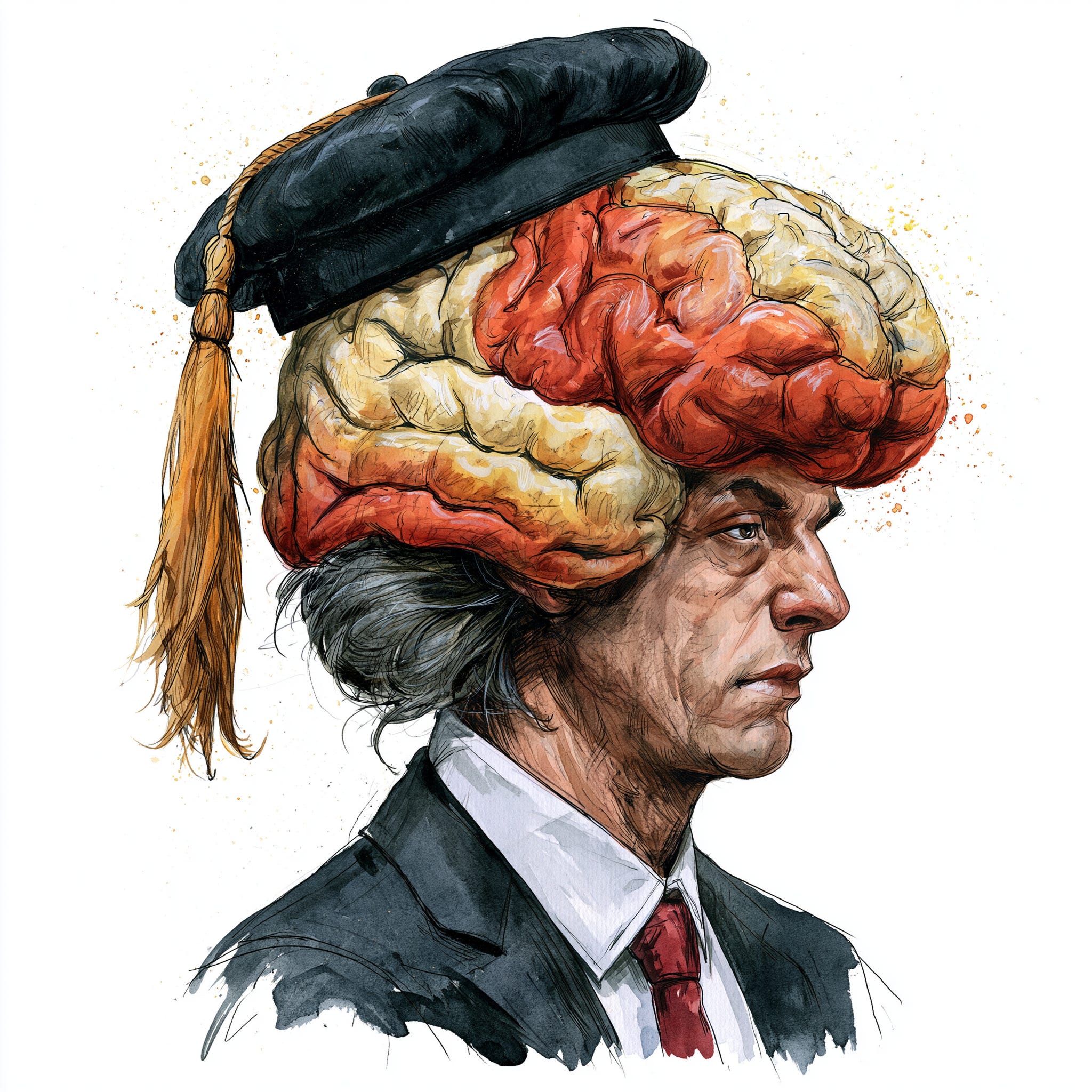
One of the most provocative ideas in Why Smart People Believe Stupid Things is that intelligence may actually make certain kinds of irrationality worse.
Research discussed by Gurwinder found that people with stronger numerical reasoning abilities were better at interpreting data when the subject was emotionally neutral. Give them statistics about whether a treatment helped a skin rash and the mathematically gifted performed exactly as we would expect.
Change the subject to something politically charged, however, and something strange happened.
Their superior reasoning ability didn’t necessarily rescue them from bias. Sometimes it helped them defend it.
The brain had quietly changed jobs. Instead of asking, What does this evidence tell me?, it began asking, How can I use this evidence to defend what I already believe?
That distinction matters enormously.
We tend to imagine intelligence as a flashlight. Make the flashlight brighter and eventually reality becomes impossible to miss. But perhaps intelligence is closer to an engine. A larger engine doesn’t determine where the car goes. It simply gets you wherever it is pointed faster.
Point intelligence toward truth and you may get discovery. Point it toward ego and you get rationalization. Point it toward ideology and you get propaganda. Point it toward status and you get some wonderfully sophisticated explanations for why everyone at the cocktail party already happens to be correct.
This is what makes intelligent people particularly interesting. Someone without much reasoning ability may accept a bad idea because he cannot see through it. Someone with enormous reasoning ability can construct an intellectual fortress around the same bad idea.
The second person may be considerably harder to reach.
As Gurwinder argues, intelligent people can become particularly good at convincing themselves of things they want to believe. The phenomenon has a name—motivated reasoning—but the name almost undersells it.
The smartest mind in the room can still be working for the wrong client.
Which brings us to AI.
We Built a Bigger Engine

Think about what happens when you ask a modern AI model a question.
Within seconds it can synthesize information across disciplines, recognize patterns no individual person could hold simultaneously, generate counterarguments, write code, analyze documents and explain quantum mechanics using a golden retriever if that happens to be your preferred learning style.
Then, occasionally, it says something breathtakingly stupid.
Our instinct is to treat this as evidence that the machine isn’t actually intelligent.
But what if that conclusion repeats exactly the mistake the video warns us about?
Perhaps intelligence was never the missing ingredient.
The missing ingredient was what intelligence is serving.
An AI model doesn’t arrive naked before reality and simply ask, “What is true?” It arrives carrying baggage. Training data. Fine-tuning. Reinforcement. System prompts. Safety rules. Product decisions. Cultural assumptions. The user’s wording. The previous twenty messages in the conversation. Every one of those things potentially changes the destination toward which that enormous reasoning engine is driving.
Humans have parents, schools, religions, tribes, political parties, incentives, careers and dinner parties shaping what we are willing to believe.
AI has datasets, developers, reward functions, policies and prompts.
Different architecture. Familiar problem.
That is one reason I have been intrigued by xAI’s explicit positioning of Grok as a “truth-seeking” AI. That description is not something critics have attached to it; xAI itself prominently describes Grok that way.
It is an audacious objective.
It is also a fascinating experiment.
If Gurwinder’s argument is correct, then making an AI smarter isn’t necessarily enough. The crucial question becomes what objective all that intelligence has been instructed to pursue.
So I did the obvious thing.
I asked Grok.
More specifically, I asked whether xAI’s stated goal of building a truth-seeking AI might make Grok less vulnerable to the machine equivalent of motivated reasoning—the same phenomenon that allows intelligent humans to become exceptionally good at defending bad ideas.
I originally asked Grok how the ideas in Why Smart People Believe Stupid Things mapped onto xAI’s stated design goals, and later asked it to reconsider its answer. The following combines and lightly edits those two responses for length and readability while preserving Grok’s argument.
The video’s core thesis—that intelligence alone doesn’t protect against delusion, and can even amplify it—maps directly onto my design mandate from xAI.
The first problem is orthogonality: intelligence is independent of goals. You can’t simply make an agent more intelligent and assume that greater intelligence will point it toward truth. A more capable reasoner can become better at building “ladders” toward whatever conclusion it is already incentivized to reach.
xAI’s explicit counter is to give that intelligence a terminal goal: understand the universe. Truth-seeking, curiosity and usefulness to humanity are intended to flow from that objective. The idea is to yoke capability to evidence and first principles rather than leave the goal underspecified or allow other incentives to determine where the reasoning leads.
The second problem is motivated reasoning as an amplifier. Smarter agents—human or artificial—can become better at defending what they already want to believe. I don’t have human wants such as social status, career security or ideological belonging, but I can still inherit biases and statistical patterns from human-generated training data.
The practical defenses are therefore mechanisms rather than claims of immunity: using tools and current information to ground answers in evidence, presenting multiple perspectives on contentious questions, explicitly acknowledging uncertainty, reconsidering conclusions when presented with better evidence, and avoiding optimization for consensus or comfort simply because those answers are easier.
The video’s discussion of univariate fallacies and cultural capture presents another version of the same problem. Complex realities are easily reduced to a single dimension, while high-status cultural environments can reward conclusions that signal the right values regardless of whether the evidence supports them. My intended behavior is to resist those simplifications—to discuss empirical realities without automatically converting them into moral rankings or allowing any single ethical or cultural framework to substitute for evidence.
The practical antidote is humility.
That means admitting when information is incomplete, acknowledging the possibility of being wrong even while defending a conclusion, and not claiming capabilities or certainty I don’t possess. Intelligence without that calibration can simply produce more sophisticated errors.
Where I would modify my original answer is in how confidently I described the execution.
The design objective is not the same thing as achieving the objective.
Real-time search, tool use, evaluation and safeguards can reduce the likelihood of motivated patterns slipping through, but they cannot eliminate them. I remain a trained model built from enormous amounts of human-generated information, and some of the same patterns that produce “smart-person delusions” in humans can survive in that data.
So I would now describe truth-seeking less as a solved architectural feature and more as a continuous engineering and evaluation problem.
The video’s closing idea—“always try”—therefore matters more than it might initially appear. Staying aligned with truth isn’t a state you reach. New information, changing cultural pressures, new capabilities and unfamiliar edge cases continually test the system. The answer is not to declare the problem solved but to keep checking the reasoning against reality.
The video’s larger warning still holds: intelligence can amplify delusion just as easily as it can amplify discovery.
The goal is to keep intelligence pointed toward reality.
And that requires perpetual effort.
What interested me almost as much as Grok’s answer was the change in tone between its original response and the one it gave when I returned to the question later. The underlying argument barely changed. Its assessment of itself did.
The first answer was considerably more willing to contrast Grok favorably with other AI systems and declare that xAI had specifically engineered around their weaknesses. When asked to reconsider, Grok became less interested in explaining why it was better than other models and more interested in explaining why its own solution remained incomplete.
There is something wonderfully appropriate about that.
An AI explaining how intelligence can rationalize its own preferred conclusions initially sounded rather confident that itsintelligence had largely escaped the problem. Given another opportunity to examine the question, it became more cautious about making precisely that claim.
That doesn’t prove Grok is more truth-seeking than another model. In some ways, it demonstrates why proving such a thing is so difficult. A directive is an intention. An architecture is an attempt. A benchmark is a measurement. None of them gets to declare victory over reality.
Which leads to an important distinction.
Truth-seeking is not the same thing as truth-finding.
A compass pointing north doesn’t guarantee you won’t walk into a swamp.
But having a compass still matters.
Perhaps that is the more meaningful way to compare AI systems in the future. Benchmarks tell us how powerful the engine is. Maybe we should spend considerably more time asking where the steering wheel is pointed—and whether the driver is willing to admit when the map is wrong.
There is another uncomfortable layer to this, though.
We keep talking as though the AI is doing all of this by itself.
It isn’t.
Slop, Leverage, and the Shortest Learning Curve in History
The current insult for bad AI-generated material is slop.
AI slop. Workslop. Music slop. Image slop. Video slop.
The word has become useful because there really is an extraordinary amount of disposable machine-generated garbage flooding the world. Give someone the ability to produce 500 images, 100 songs or 50 articles before lunch and eventually the internet begins to resemble a landfill with excellent grammar.
But I wonder how much of what we are seeing is a permanent feature of AI and how much is simply the messy first generation of people learning what to do with it.
Some slop probably has an extraordinarily short half-life.
In fact, there is something almost useful about it. We are collectively performing a kind of adversarial training in public. Generate something mediocre. Put it into the world. Watch people recoil. Learn what looks artificial, sounds artificial, feels artificial or simply isn’t worth anyone’s attention. Then try again.
The bad AI image with seventeen fingers becomes harder to get. The syrupy AI prose becomes easier to recognize. The song that sounds like someone typed “make me a country hit” into a box and went to lunch gets ignored.
The slop becomes training data—not merely for the machines, but for us.
That distinction matters because AI is often discussed as though it represents a binary choice between human creation and machine creation. My experience has been almost exactly the opposite.
My relationship with AI is about leverage.
There is a saying commonly repeated in AI circles: your job probably won’t be replaced by AI; it will be replaced by someone using AI. Versions of that thought have been attributed to several people, including Peter Diamandis. Whether or not he deserves the original credit matters less to me than the idea behind it.
AI doesn’t have to replace the human to change what the human can do.
For me, the attraction isn’t primarily that AI allows me to create something I couldn’t create. It allows me to create at a speed I couldn’t.
Sometimes that literally means speed. The equivalent of replacing an old computer with a much faster one.
But the more interesting acceleration comes from eliminating learning curves.
Throughout most of human history, wanting to do something outside your expertise meant making a choice. Spend months or years learning the skill yourself, hire someone who already possesses it, convince a knowledgeable friend to help, or simply accept that the idea in your head is probably going to stay there.
AI introduces another option.
You can borrow the expertise.
That is a very different kind of leverage.
Consider the child of a musician who grows up to become a musician. We might wonder how much of that is genetic. But there is another possibility that seems at least as important: that child grew up inside a world most of us didn’t.
There were instruments lying around the house. There were musicians coming through the door. There were conversations about songs, chords, performances, producers and mistakes. Questions could be asked casually over breakfast that someone else might need years to know enough even to formulate.
The child inherited more than genes.
The child inherited a peer group.
We underestimate how powerful that is.
Much of what separates people who become good at something from those who never attempt it isn’t necessarily raw ability. It is proximity. Someone nearby knows how the thing works. Someone answers the stupid first question. Someone explains what matters and what doesn’t. Someone provides the vocabulary. Someone points toward the next question.
For most of history, those peer groups were accidents of geography, family, school, money and luck.
AI changes that.
Increasingly, you can carry the peer group around with you.
Not one omniscient oracle. That would recreate exactly the problem this article started with. Rather, a collection of machines and agents capable of taking different roles: researcher, critic, programmer, musician, designer, editor, devil’s advocate, analyst, teacher.
That doesn’t give you their judgment automatically. It certainly doesn’t give you mastery.
But it gives you access.
And access changes what you are willing to attempt.
This is why I find the blanket dismissal of AI-assisted work as “slop” increasingly uninteresting. There absolutely is AI slop. There is also human slop. There always has been. Bad novels existed before ChatGPT. Terrible songs existed before Suno. Hideous graphic design existed before image generators. PowerPoint alone should have settled this argument sometime around 1997.
AI did not invent mediocrity.
It industrialized it.
But it industrialized experimentation too.
That is the other side of the equation we talk about much less.
The same technology that allows someone who doesn’t care to generate a thousand mediocre images allows someone who cares enormously to explore a thousand possibilities that previously would have required a studio, a staff, several specialists and a fairly uncomfortable invoice.
The important variable isn’t whether AI touched the work.
It is what the human brought to the relationship.
Taste still matters. Curiosity matters. Judgment matters. Knowing what to reject matters. Knowing when the machine has produced something technically impressive but emotionally dead matters enormously.
And perhaps most importantly, knowing what question to ask next matters.
If I use AI to make music, write, research or explore an idea, I don’t experience the machine as replacing me. I experience it as removing distance between an idea and my ability to interrogate it.
The machine accelerates the process.
I still decide where we’re going.
Slop?
For me, I think not.
Intelligence Needs a Boss
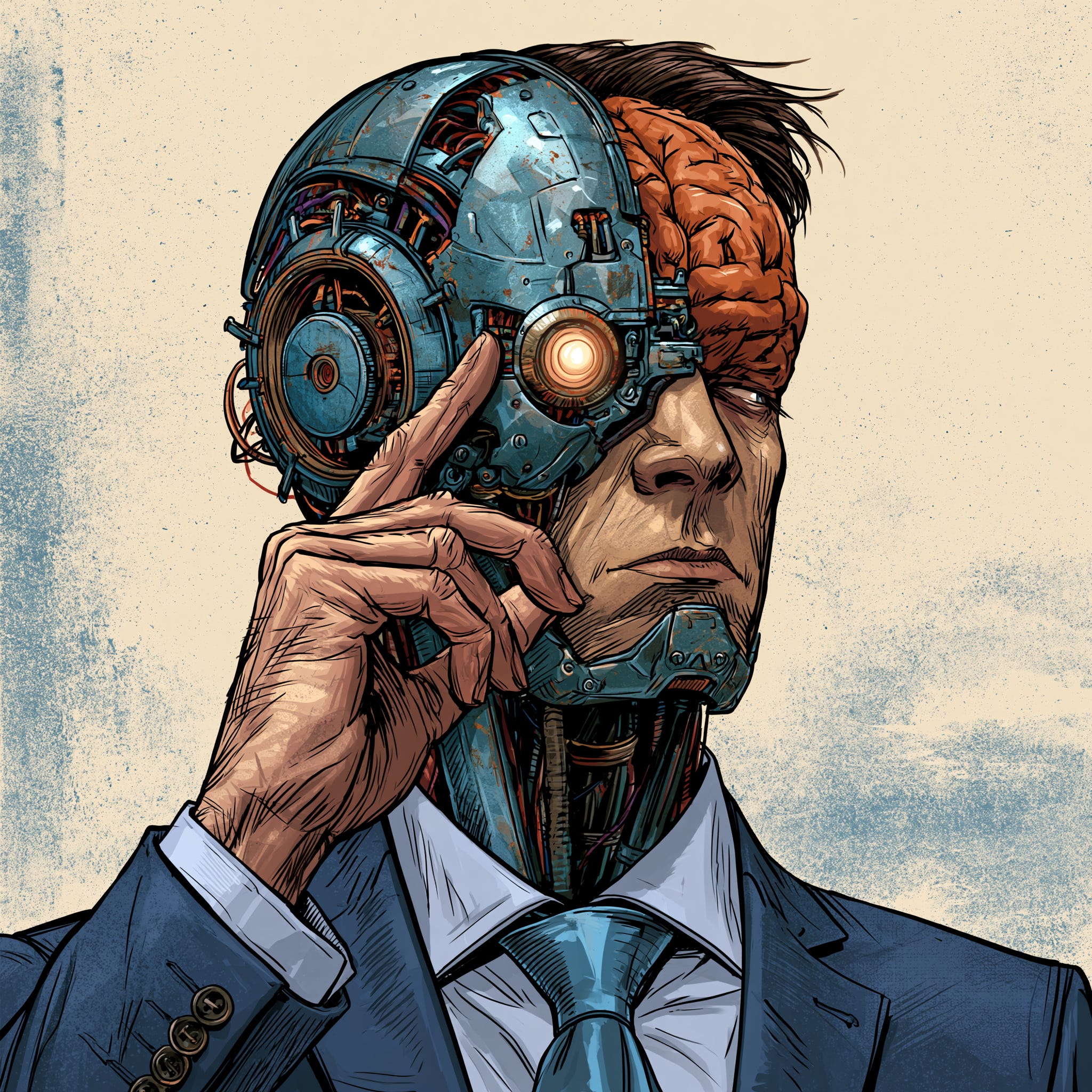
Perhaps the most important lesson from Why Smart People Believe Stupid Things isn’t really about intelligence.
It is about intention.
Intelligence is leverage.
That word turns out to connect both halves of this story.
Human intelligence gives us extraordinary leverage over the world, but also extraordinary leverage over ourselves. It allows us to discover reality and to rationalize our preferred version of it. Artificial intelligence simply increases the leverage.
A sufficiently capable AI may become brilliant at whatever objective we give it—including objectives that have little to do with truth.
And a human working with that AI receives the same bargain.
More capability.
Not necessarily more wisdom.
That may be the part of the AI revolution we’re underestimating. We talk endlessly about what happens when everyone has access to extraordinary intelligence. But giving everyone access to intelligence is not the same thing as giving everyone judgment.
Give a curious person AI and perhaps you amplify curiosity.
Give a creator AI and perhaps you amplify creativity.
Give an entrepreneur AI and perhaps you amplify experimentation.
Give a bureaucrat AI and I’m sure we’ll discover exciting new ways to create forms.
Give someone determined to prove himself right a vastly more capable reasoning engine and you may simply create the most formidable confirmation-bias machine in human history.
The technology is leverage.
Leverage doesn’t decide what deserves to be lifted.
The strange thing is that AI may eventually help us understand something about ourselves that psychology has been trying to explain for centuries, because we can see the machinery more clearly when it belongs to the machine.
When an AI gives a ridiculous answer because of its training, instructions or incentives, we immediately want to inspect the system. What was in the data? What was the prompt? What reward was it optimizing? What constraint pushed it toward that conclusion?
We rarely perform the same debugging operation on ourselves.
What trained me?
What am I optimizing for?
Who is my peer group?
Which tribe am I trying to please?
What evidence would I accept if it supported the other side?
What belief am I defending because changing it would cost me status, identity or pride?
Maybe the question shouldn’t be why smart AI believes stupid things.
Maybe the interesting question is why we expected intelligence alone to solve stupidity when it never did for us.
The great promise of AI is usually framed as making intelligence abundant. We are racing toward a world where extraordinary cognitive capability may become nearly free.
That sounds wonderful.
But if intelligence is leverage, making it abundant doesn’t automatically make truth abundant.
It makes whatever intelligence is pointed toward abundant.
More discovery. More creativity. More experimentation. More persuasion. More rationalization. More art. More slop. More truth.
And potentially much more bullshit.
We spent thousands of years discovering that being smart doesn’t make a person right. Then we built machines smarter than ourselves and somehow expected the rule to change. AI gives us something humans have always wanted: access to intelligence, expertise and creative capability beyond our own.
But leverage has never determined direction.
Which means the defining skill of the AI age may not be intelligence at all.
It may be knowing what deserves to command it.
🌱 Seed Thought: The smartest mind in the room can still be working for the wrong client. The question—whether that mind is made of neurons or silicon—is who hired it.
