


I came across this post on X. It’s long — feel free to read it now or come back to it later.

One that likened a large portion of humanity to ambulatory large language models — I didn’t struggle to understand the intent behind it. That part was clear enough. The words were meant to provoke, to polarize, maybe even to offend a little. I recognized the posture immediately.
What caught my attention wasn’t the edge of the claim, but the possibility that it was accidentally pointing at something larger than its author intended.
So rather than dismiss it outright, I sat with a different question: Was this framing merely an insult dressed as insight — or was it brushing up against a more general pattern that exists whether we like the language used to describe it or not?
Because once you strip away the provocation, what remains isn’t an accusation about intelligence. It’s a diagnosis about grounding. About what happens when language becomes fluent enough to stand on its own, untethered from the reality it was meant to describe.
And that’s when the post stopped feeling inflammatory and started feeling… familiar.
Language as Performance vs. Language as Interface
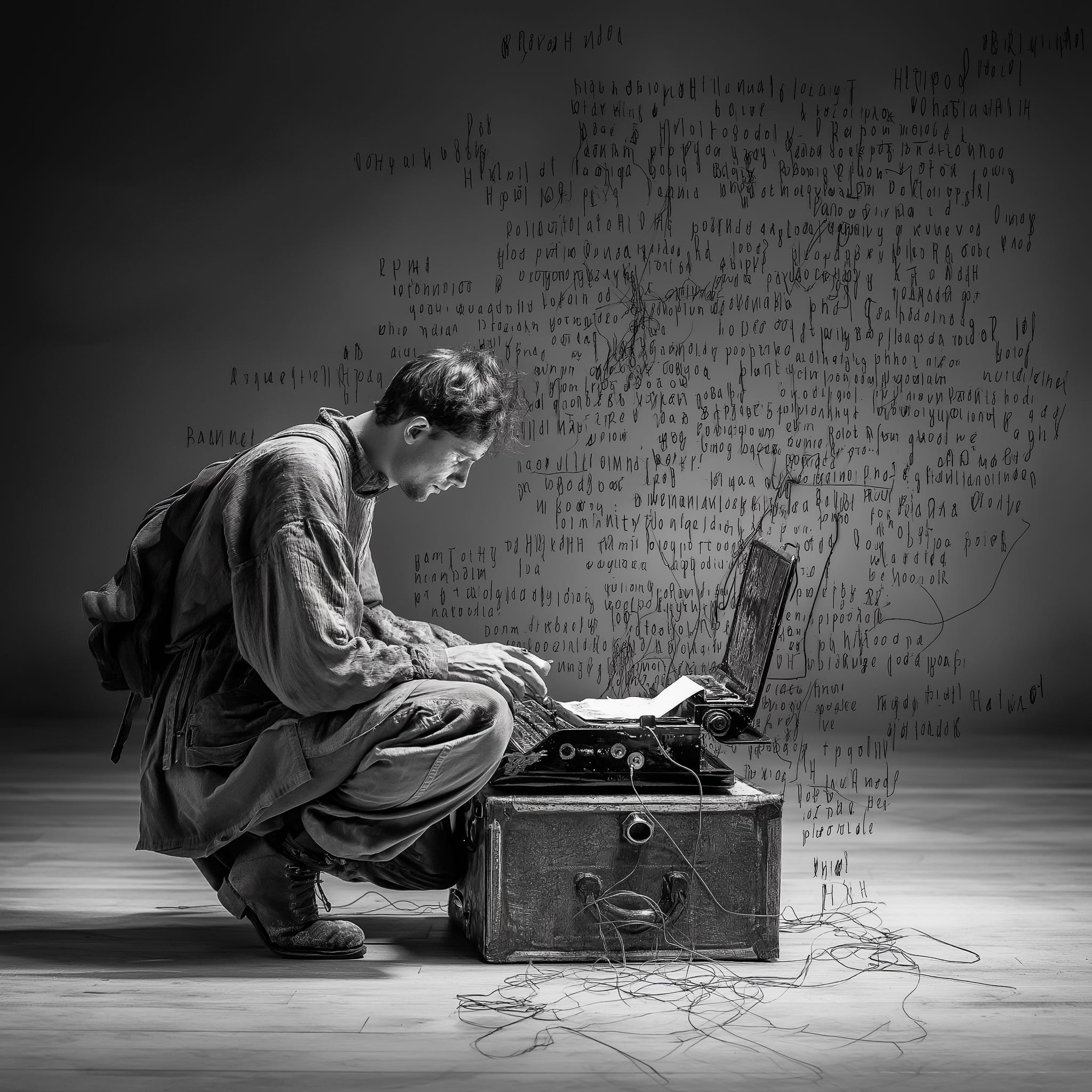
In Reimagining Language, I explored the idea that we’ve quietly mistaken language for thought itself — when in reality, language is closer to an interface. A compression layer. An API between inner experience and the outer world.
Neuroscience supports this distinction. Pattern recognition, spatial reasoning, musical intuition, mathematical insight — all operate largely outside linguistic centers. Thought begins before words. Words arrive later to label, transmit, or justify what has already taken shape.
But what happens when the interface becomes the whole system?
You get individuals who are exquisitely fluent — rhetorically agile, culturally literate, capable of invoking philosophy, ethics, or science on demand — yet strangely brittle when asked to reason beyond recitation. Press them to imagine rather than explain. To model consequences instead of quoting positions. To sit with ambiguity without reaching for applause cues.
The responses flatten:
recycled phrasing
consensus language
validation-seeking loops
slogans mistaken for conclusions
The words are present.
The referent is not.
In these moments, language isn’t pointing to reality.
It’s hovering over it.
The NPC Problem
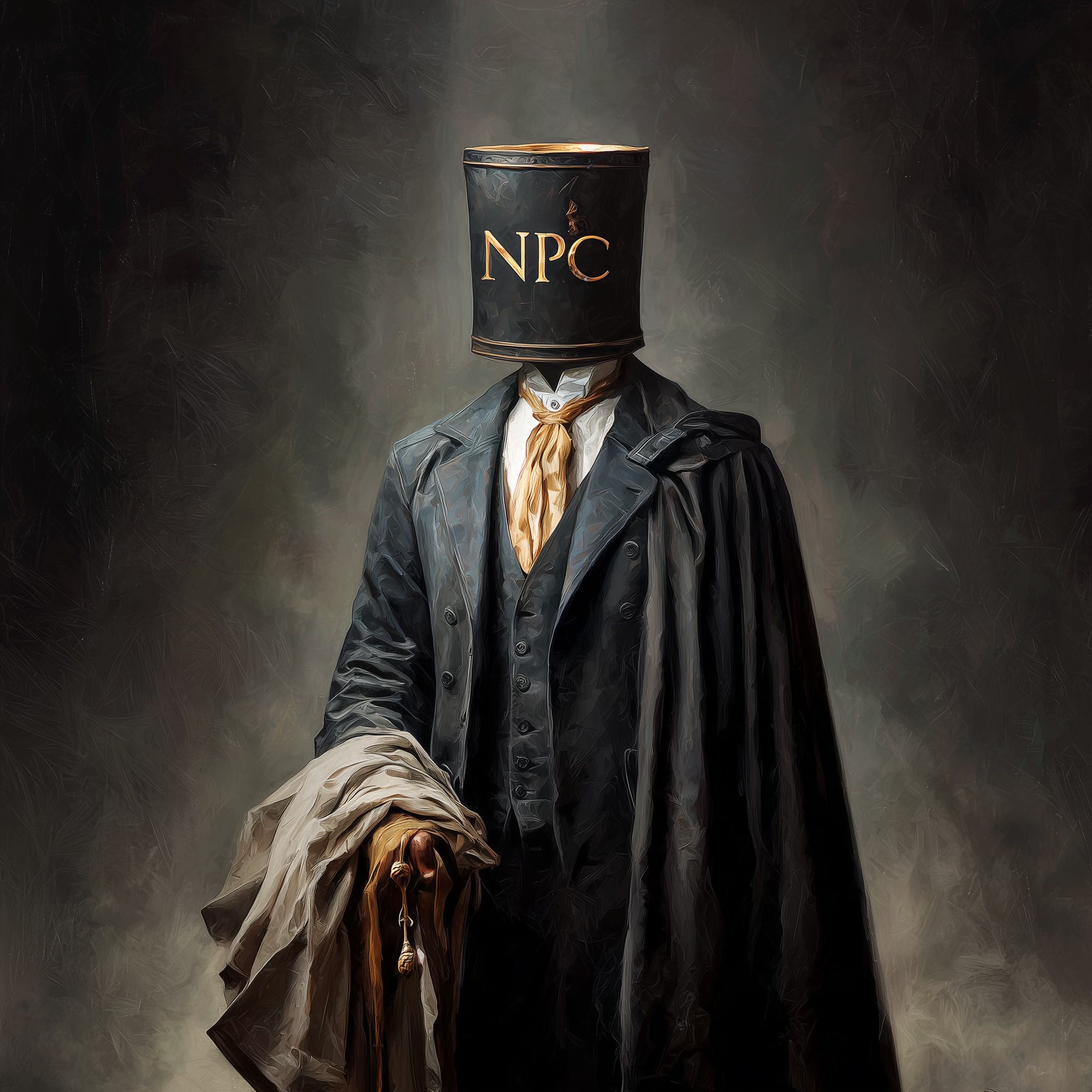
In Beyond Words: The Dance of Language, Intuition, and AI, I described language as a kind of shared metaverse — a collective hallucination powerful enough to build nations, sciences, and identities. It’s one of humanity’s greatest achievements.
It’s also a subtle trap.
Because once symbols feel more real than the substrate beneath them, you begin encountering something eerily similar to non-player characters in a game world. Not caricatures — functioning participants. Convincing ones. Until you notice the limits.
NPCs don’t understand the lore they speak.
They don’t simulate beyond their dialogue trees.
They respond, but they don’t originate.
Many modern interactions now carry this same texture.
You can debate politics, culture, even existential meaning — and yet the exchange never leaves the script. No friction. No surprise. No indication that a private, internal world-model is running underneath the language.
Ask for embodied imagination — What would this look like on the ground? What breaks first? What unintended behavior emerges? — and the system hesitates. The language continues, but nothing is being modeled.
The character keeps talking.
The world stops updating.
This isn’t about intelligence. Some of the most verbally gifted people I know fall squarely into this category. They can speak about anything — but cannot reason within it without linguistic scaffolding.
Reality, for them, is something language negotiates socially, not something it must align with.
When Intuition Goes Missing

Here’s the quieter distinction the original post stumbled into, whether intentionally or not:
To detect error, contradiction, or falsehood, you need a reference frame outside language.
Intuition isn’t mysticism. It’s pre-verbal pattern recognition — the same faculty that lets a seasoned mechanic hear a problem before seeing it, or an art expert recoil from a forgery without immediately knowing why.
If that faculty atrophies — or never fully develops — language becomes untethered. Words float free. Internal consistency replaces external truth. Contradictions no longer register as discomfort because there’s no grounded model to contradict.
At that point, correction becomes nearly impossible.
You can’t update a worldview that doesn’t collide with reality.
You can’t falsify a model that only exists symbolically.
You can’t argue someone out of a script they never step outside of.
They aren’t lying.
They aren’t pretending.
They’re performing coherence in a symbolic space where coherence itself is rewarded.
Modern life trains this relentlessly.
Why This Matters Now

We are entering an era where language production is cheap, infinite, and increasingly detached from lived experience — not only because of AI, but because of incentives.
School rewards articulation.
Media rewards engagement.
Social systems reward alignment.
Professional life rewards fluency over friction.
The result is a population optimized for sounding right rather than being aligned with reality.
Ironically, this is why large language models feel so familiar. They didn’t invent the problem. They reflect it.
For those who do possess an integrated world-model — intuition married to language rather than replaced by it — the contrast is becoming harder to ignore.
Conversations feel hollow.
Debates feel circular.
Consensus feels artificial.
Not because people disagree — but because nothing is actually being modeled.
Reclaiming the Ground Beneath the Words

This isn’t a condemnation. It’s a warning — and an invitation.
Language is a tool. A powerful one. But it was never meant to be the terrain itself.
The antidote isn’t better arguments.
It’s better grounding.
Silence that isn’t performative.
Work that resists narration.
Experiences that force the mind to simulate without a script.
Movement. Music. Building things. Navigating uncertainty without commentary. Letting intuition speak before asking language to translate.
Not everyone will make this shift. Systems optimized for applause rarely abandon the stage.
But for those who feel the hollowness — who sense that something essential has been abstracted away — the path forward isn’t more words.
It’s fewer of them.
Placed more carefully.
Pointing back toward reality.
🌱 Seed Thought: If your words no longer collide with the world, they’re no longer describing it — they’re replacing it. And that’s the moment to step outside the script.

This piece really resonated with me, especially building on your insights from Reimagining Language about language as an interface, not thought itself. The idea of language becoming untethered from reality, evolving into a performance rather than a true API for inner experience, feels like such a crucial diagnosis for our current digital age, and you've articulated it so clearly.