


Before We Begin
This is a story about coding—but not in the way you think.
If you’ve never written a line of code, you’re not behind—you might actually be closer to the point. And if you have coded before, this may feel even stranger, because it challenges something you’ve probably believed for decades: that building something requires understanding how it works.
It used to.
This story isn’t about learning SNMP, or Swift, or encryption protocols. Those show up—but only as characters passing through the scene. The real subject is something quieter and far more disruptive: what happens when you can build things without carrying the full weight of how they’re built?
What follows is not a tutorial. It’s an experience—one that starts with a simple question, drifts into unfamiliar territory, and slowly reveals that the rules underneath it all may have changed more than we realize.
If you’re expecting step-by-step instructions, this won’t give you that.
If you’re curious about where the edges are moving—and what that might mean for how we all work, build, and create—then it’s worth staying with.
Because somewhere along the way, this stops being a story about coding…
…and starts becoming a story about leverage.
Before we step into the story, it helps to know what world we’re walking into. Not in detail—just enough to recognize the landmarks as they pass by.
Switch: Think of it as a highly organized traffic controller for data. Every device on a network—computers, cameras, access points—plugs into it. Its job is to make sure information gets where it’s supposed to go, efficiently and quietly.
PoE (Power over Ethernet): One cable. Two jobs. It carries data and electricity. That means things like cameras or Wi-Fi access points don’t need separate power—they come alive through the same wire that connects them.
SNMP (Simple Network Management Protocol): A long-standing, slightly awkward, but incredibly useful way to ask devices questions and sometimes tell them what to do. It’s less like a modern app and more like speaking in precise, numbered phrases that machines understand.
LLDP (Link Layer Discovery Protocol): Devices quietly introducing themselves to each other. “Here’s who I am, here’s what I’m connected to.” It’s how a network builds a kind of awareness of its own structure.
SSH / CLI: The command line version of knocking on a device’s door and saying, “Let me in, I know what I’m doing.” Powerful, direct… and not particularly forgiving.
REST API: A more modern, structured way for software to communicate. Clean in theory. In practice, only as good as whoever built it.
Encryption (SHA, authentication, etc.): The part that makes sure when you’re talking to a device, it’s really you—and that no one else is quietly listening in or pretending to be you.
The Idea That Didn’t Feel Like One
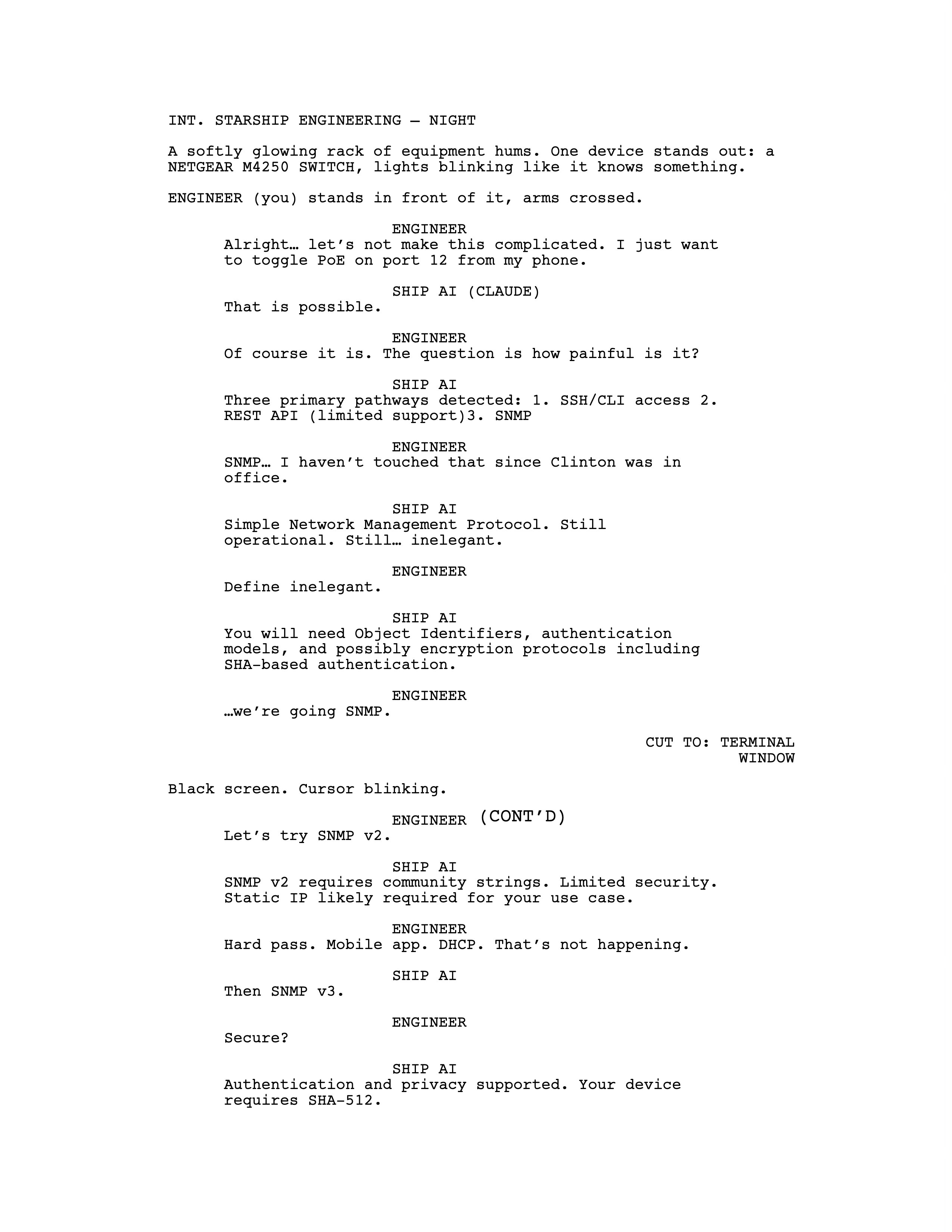
It didn’t begin as a prompt—it began as friction. The switch worked, the cloud worked, everything technically worked. But something about routing control through a remote layer for hardware sitting ten feet away felt off. Not broken—just indirect. The kind of inefficiency that doesn’t justify action… until it suddenly does.
That’s when the thought surfaced: Could I just talk to it directly? And almost immediately after: Could I build something to do that from my phone? Not a plan. Not even a goal. Just a question that refused to go away.
Familiar Words, Unfamiliar Terrain
When SNMP entered the conversation, it wasn’t new—it was remembered. Like pulling an old tool out of a drawer and realizing you still recognize it, but you’re no longer sure how to use it. BASIC. Assembly. C. There was a time when this was native ground. Now it was more like a map you could read, but not navigate instinctively.
And that’s where this could have ended. Not because it was impossible—but because it sat in that dangerous middle ground: possible, but annoying. Instead, something else happened. Instead of solving, you started asking. And the answers kept coming—not as lectures, but as directions.
Proving It’s Real
Before apps, before Swift, before anything ambitious, there was a single binary question: Can I talk to the switch?Terminal became the testing ground. SNMP v2 fell apart quickly—static IP requirements killed the mobile idea. SNMP v3, though, had promise. Authentication, encryption, real control.
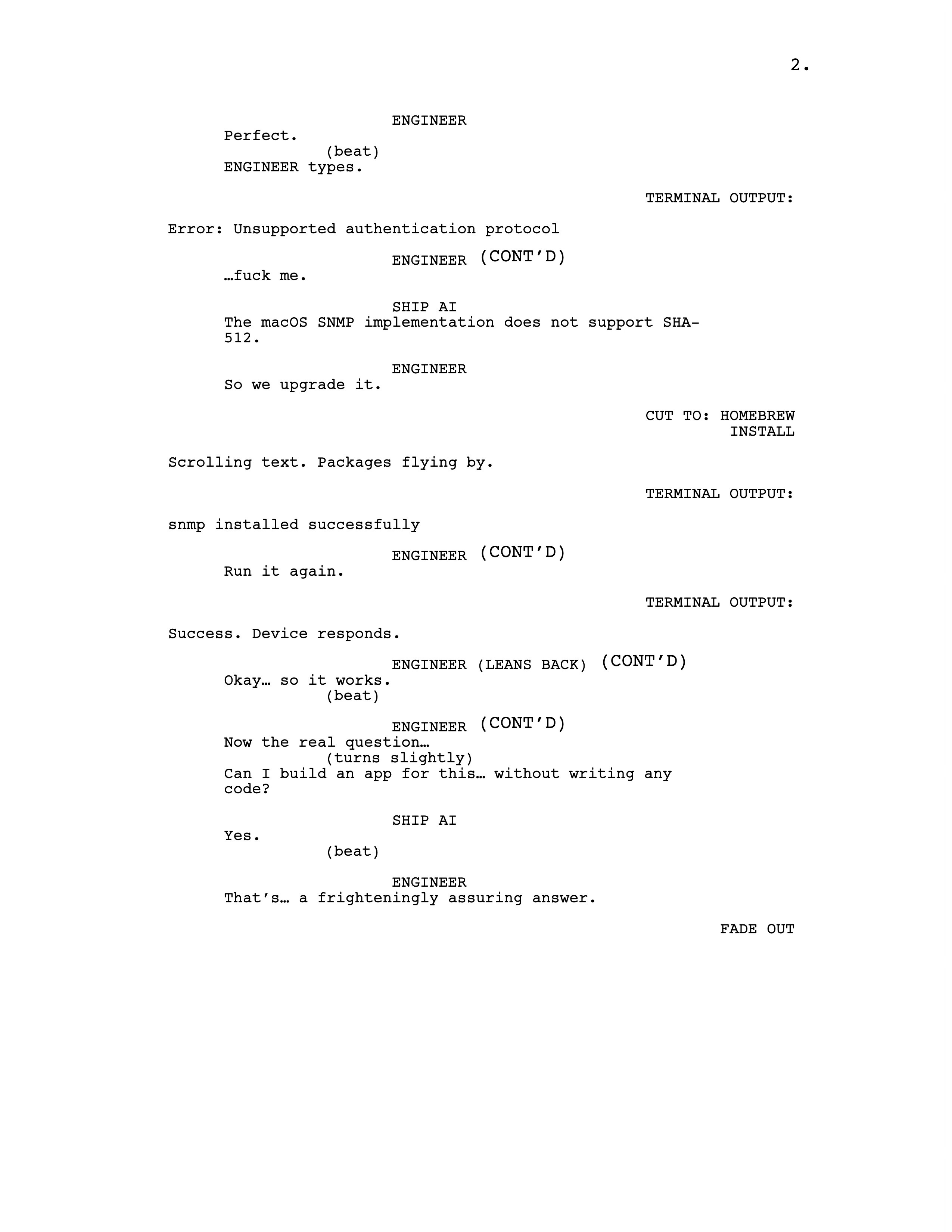
Then came the first wall: SHA-512. Supported by the switch. Not supported by macOS.
That kind of mismatch used to stall everything. Not because it was unsolvable—but because it required just enough digging to drain momentum. This time, instead of digging, you delegated. Upgrade via Homebrew. Try again. Success.
And just like that, something subtle shifted: you weren’t solving problems—you were moving through them.
A Different Kind of Build
Once the switch responded, the path forward wasn’t fully clear—but it was undeniable. If communication was possible, then everything else was just layers. And that’s when the real question emerged, sharper than the first: Could I build the entire thing without writing code?
Not as a shortcut—but as an experiment.
Because underneath the technical steps, a deeper shift was already underway. The question had changed from how do I build this? to how do I describe this well enough for something else to build it?
That’s not an incremental improvement.
That’s a different paradigm entirely.

🌱 Seed Thought: You don’t need to understand everything anymore. But you do need to recognize what should be possible
