


Before We Continue
Up to this point, the experience has been accelerating—ideas turning into working systems faster than they should. But speed has a cost. Not failure exactly… but fragility. Part III is where that shows up. Eventually something breaks in a way that can’t be ignored, and the only way forward is to engage a layer you never intended to understand. Not fully—just enough.
When Momentum Meets Reality
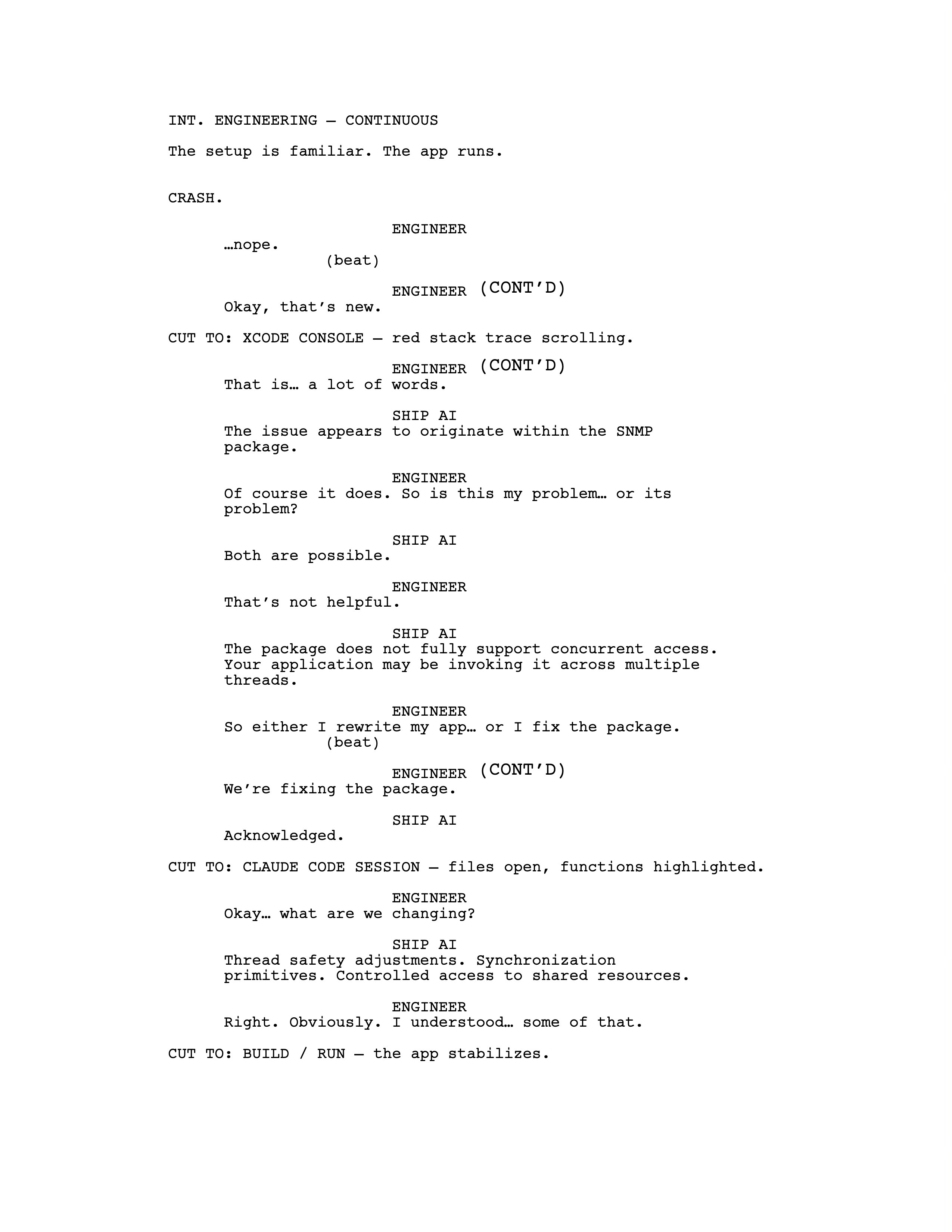
Up to now, progress had a rhythm—fast, iterative, forgiving. But systems don’t stay forgiving. Eventually they reveal where the abstraction thins. The crash was the signal. Not dramatic, just enough to interrupt the flow and force a harder question: where is this actually breaking? For the first time, the answer wasn’t obvious.
Crossing the Boundary
When the issue pointed to the package, the choice became simple: work around it or go deeper. Earlier, modifying a library felt optional. Now it felt necessary. Concurrency, thread safety, shared state—concepts you recognize but don’t fully command. And yet you stepped in. Not to master them—just to move through them.
The Role That Didn’t Exist Before
This is where the experience becomes difficult to categorize. You’re not writing the code, but you’re not passive either. You’re identifying where the problem lives, asking the right questions, interpreting just enough to act. Somewhere between operator and engineer—a role that didn’t quite exist before.
The Line That Explained Everything
Then came the moment—the one every builder eventually meets, but rarely understands in full.
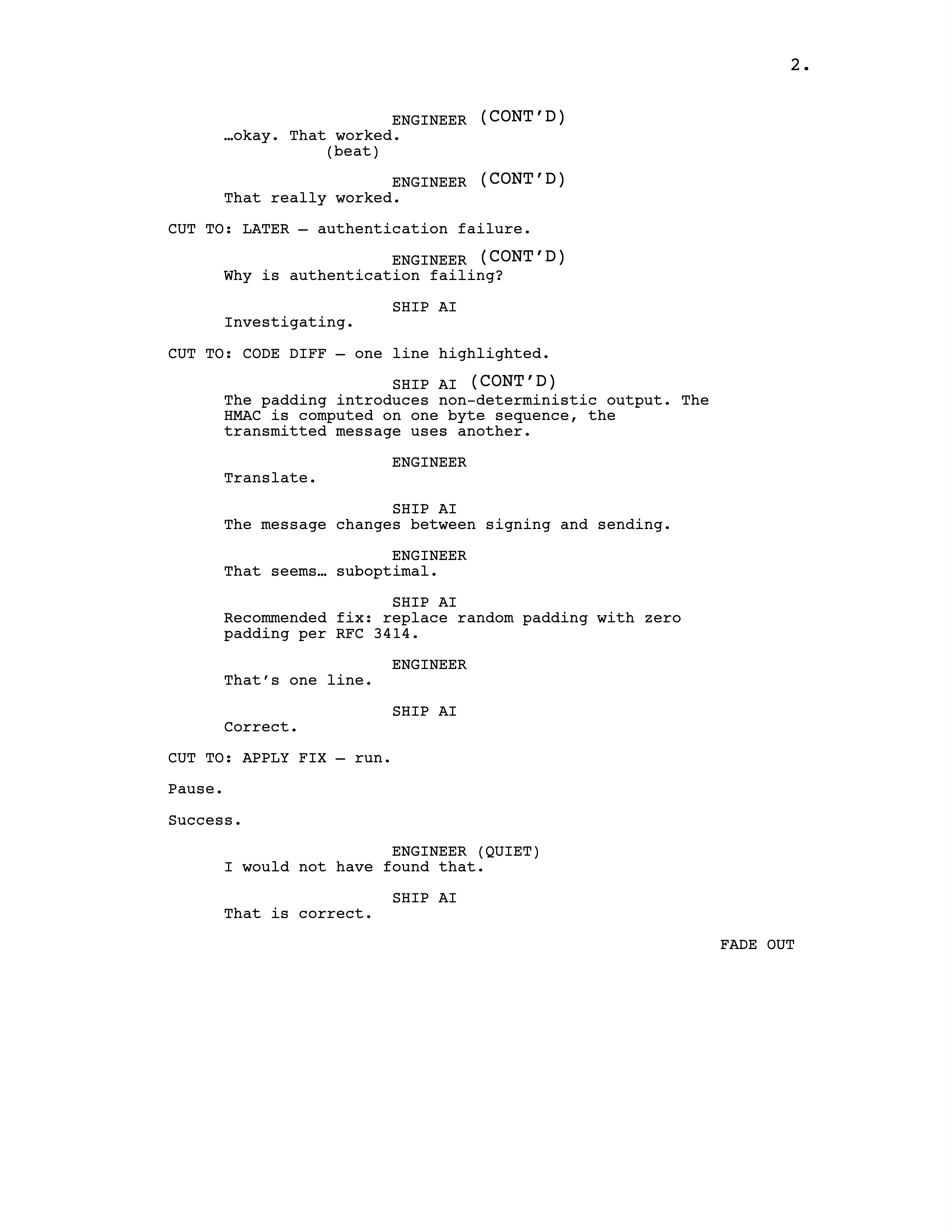
Nothing obvious was broken. The code compiled. The logic flowed. The system behaved… almost correctly. But authentication failed just enough to make it clear something deeper was off—the kind of problem that doesn’t announce itself, it whispers.
And then this surfaced:
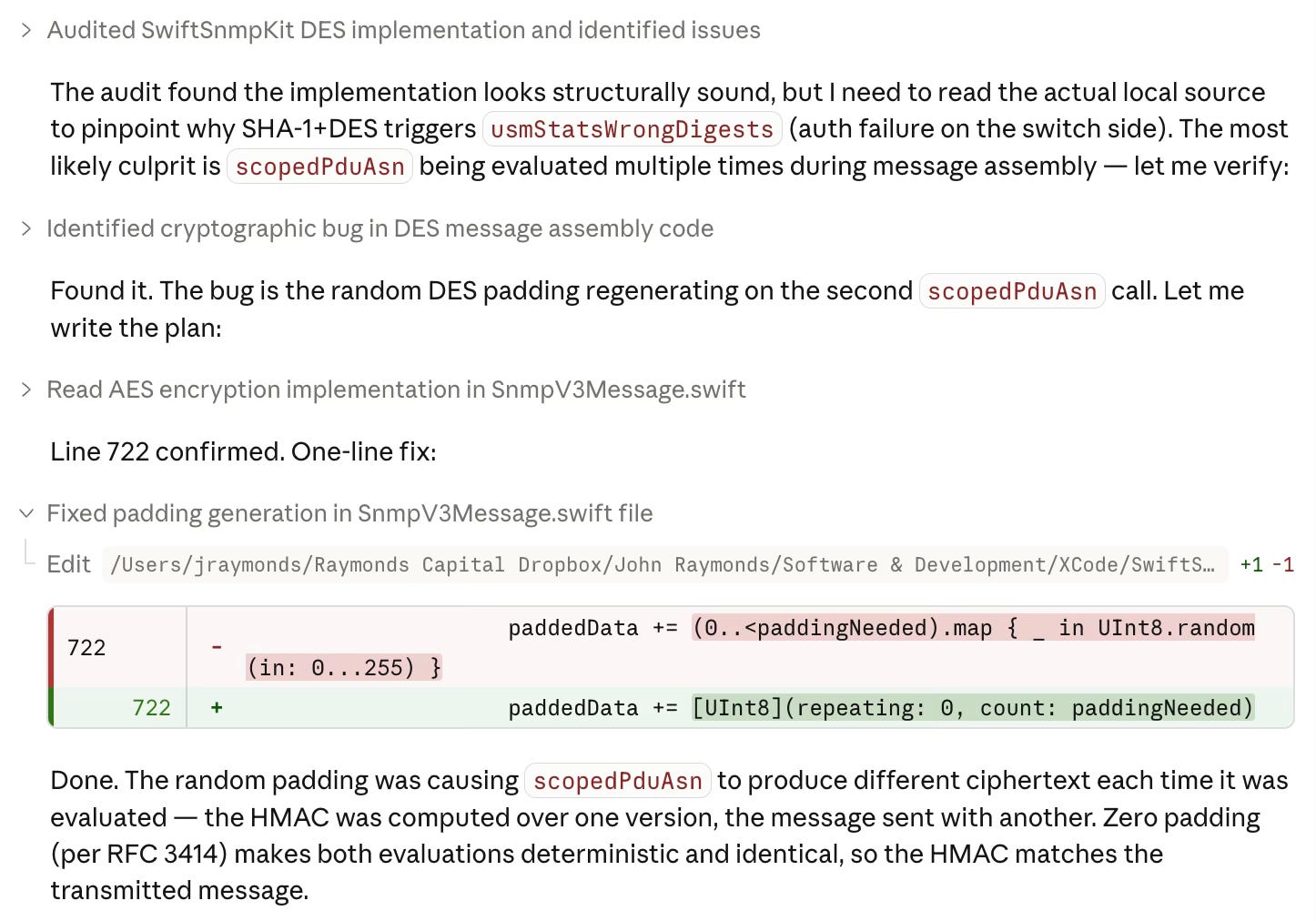
One line. Not a typo. Not bad code. The implementation was structurally sound—clean, even. And yet it violated something invisible: the protocol itself. The padding was random, which meant the message being signed was not the same as the message being sent. The HMAC—computed correctly—was validating the wrong thing.
Nothing was “broken.” Everything was just… slightly misaligned. And in cryptography, slightly is the same as completely.
Why That Matters
This is the part that’s hard to fully appreciate unless you’ve lived inside systems like this. To find that bug manually, you would need to understand the SNMP v3 message structure, the role of scopedPduAsn, how HMAC validation is computed, the difference between deterministic and non-deterministic padding, and the expectations defined in RFC 3414—not conceptually, but precisely, across execution paths.
That’s not one layer of knowledge—it’s a stack: protocol, cryptography, implementation detail, execution order. And the failure didn’t exist in any one layer. It existed between them.
The code did what it said. It just didn’t do what the system required.
That kind of gap usually takes hours—if not days—of tracing, logging, reading specs, and second-guessing assumptions. Here, it resolved to a single line—not because the problem was simple, but because the system helping solve it could hold the entire context at once, something no single human typically does.
The Limit That Wasn’t
There’s always a moment where you expect to hit the edge—where abstraction fails and progress stops. This should have been it. It wasn’t. Because the system didn’t require full understanding. It required recognition, direction, and the willingness to stay in the loop.

🌱 Seed Thought: You don’t need to understand every layer. You just need to know when something doesn’t make sense—and stay with it long enough to find the line that fixes it.

m