A Page in the Dark
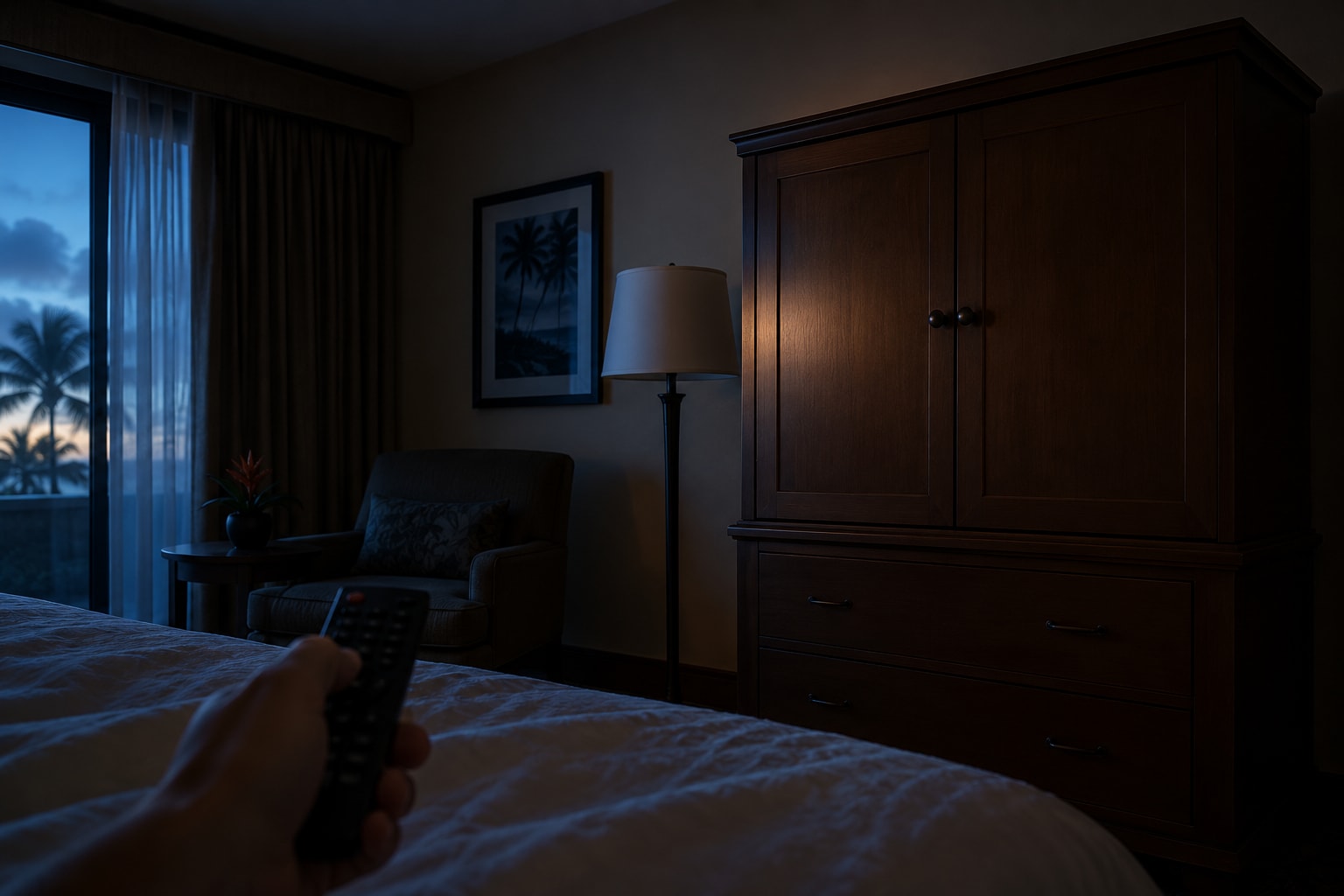
I was in Hawaii on September 11, 2001, attending a Life Mastery event with Tony Robbins. I remember getting a page from a coworker back in New Jersey. If you remember pagers, there is a decent chance you were alive when 9/11 happened.
The message was something to the effect of: A plane crashed into the World Trade Center. Probably terrorism.
It was still dark in Hawaii. I grabbed the television remote and started pressing buttons. Nothing. I pressed harder. Tried again. Nothing. For a few confused seconds, I wondered why the television wasn’t responding. I wasn’t awake enough to imagine that whatever was happening on the mainland had somehow reached Hawaii. I was not even awake enough to notice something much more obvious.
The television cabinet was closed.
The remote couldn’t see the television, and I couldn’t see the television.
Once I figured that out, the story began coming together. By the time I got the television on, much of what would turn September 11 into 9/11 had already happened.
Later, walking outside into a crisp Hawaiian morning, I passed some people sitting at a table on the way to the convention center. I told them what had happened. They barely responded. I still wonder whether they thought I was some crazy guy wandering past their breakfast table talking to himself about airplanes and collapsing buildings.
At the convention center, history took over the event. Tony Robbins has since shared footage from that day, and it captures what happened there far better than I ever could. As for what that day was like for me, YouTube probably tells the story better than anything I could reconstruct twenty-five years later.
I don’t remember every detail anymore. I remember the feeling.
And there is an important difference between the two.
When Memory Stops Being Shared
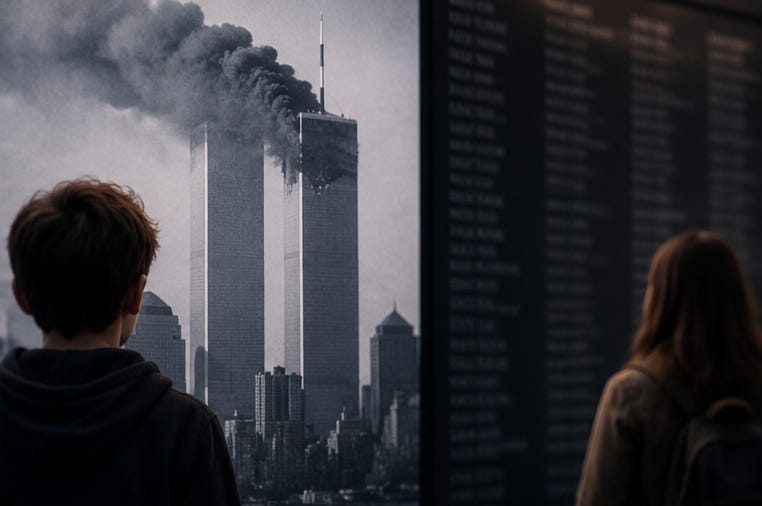
When something enormous happens during your lifetime, you unconsciously assume everyone else lives with the same reference point. They may disagree about what it meant. They may disagree about what should have happened afterward. They may have experienced it from New York, California, Hawaii, Europe, or somewhere else entirely.
But at least they were there.
Twenty-five years changes that. A surprisingly large percentage of the adults walking around today were either children on September 11, 2001, or hadn’t been born yet. Of course they can learn what happened. They can read about it, watch the television broadcasts, see the photographs, listen to recordings, visit the memorial, or follow one of the accounts on X that recreated the events in real time.
But knowing what happened is not the same as having lived while it happened.
There is a kind of second-order information loss that occurs as time passes. First we lose the event itself. Then we begin losing the people who remember the world on both sides of it. That second loss is harder to notice because nothing disappears all at once. The memory just becomes a little less shared every year.
George Santayana famously wrote, “Those who cannot remember the past are condemned to repeat it.” The difficulty is that eventually remembering becomes impossible. You can learn the past. You can study it. You can even understand it extraordinarily well. But you cannot remember something you never experienced.
As time marches forward, more and more of history moves across that boundary. What was once common memory becomes inherited knowledge.
That distinction matters.
Until They Stay
Which brings me to something Palmer Luckey posted on X on the 25th anniversary of 9/11:
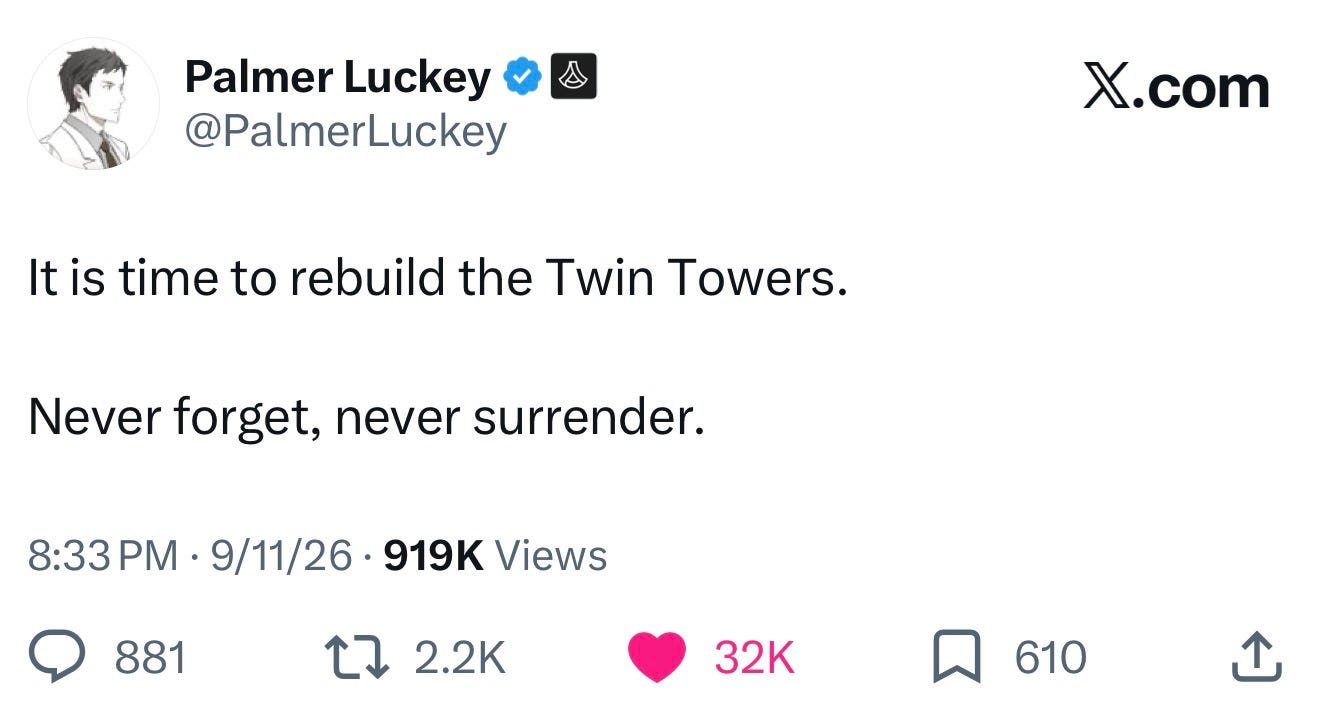
I don’t know whether he meant it literally. But the moment I saw it, I remembered something I had almost forgotten myself.
On February 18, 2002, barely five months after the attacks, I wrote a letter to President George W. Bush. I have no idea whether anyone meaningful ever read it, much less the President. This is what I wrote, lightly edited here only to correct typos and punctuation:
Mr. President,
When something we value is destroyed, we rebuild it. If it’s destroyed again, we rebuild it again. And again, and again, and again. Until it stays.
That, as our poet Tennyson once said, is the goal: “To strive, to seek, to find, and not to yield.”
In this time of change for America, I believe we must be diligent in ensuring the symbols of greatness never sway. The terrorists in New York took away more than life and a sense of security with their actions; they also took away one of America’s emblems of greatness, and indeed this was no accident.
The action you have directed our nation to take in Afghanistan, combined with the uniting of the world around a cause of intolerance of terrorism, is on a scale I am sure none of the “Evil Doers” contemplated. The patriotism of America in the face of adversity is something my heart is glad to be a part of. Our power and the influence of good shall smoke out the cowards wherever they might try to hide. More adversity will only strengthen the spirit of America.
Yet, I believe there is still one piece missing: the Evil Doers still think they can destroy our material symbols of greatness.
At a time when tax dollars are spent to protect us, I believe we must also spend to show those who use terror as a weapon that nothing can ever be taken away.
Let us, as a nation, rebuild the towers as they were. Again, and again, and again, if needed.
Until they stay.
—John Raymonds
Would I write exactly the same letter today?
If 9/11 happened today, I think I probably would.
That is different from saying I think we should tear into what exists at Ground Zero now and rebuild the Twin Towers in 2026. History has already forked. The memorial exists. A generation has grown up with the site as it is. The absence of the towers has itself accumulated meaning, grief, and memory. You cannot rewind twenty-five years and pretend none of that happened.
Palmer Luckey’s post made me think about the branch we didn’t take.
In the months immediately after September 11, there was still a choice to be made about what destruction was allowed to accomplish. My answer then was simple: rebuild the towers as they were.
Not approximately.
Not something inspired by them.
Put them back.
Until They Stay.
When I imagined rebuilding the towers in 2002, I did not imagine replicas that simply reproduced what had been destroyed. From the outside, I wanted them to look essentially the same. That was the point. Someone had attempted to permanently remove those shapes from the New York skyline. My response was that they should eventually look up and see them standing there again.
But underneath the skin, everything should have been stronger.
Stronger structure. Stronger fire protection. Stronger evacuation systems. Stronger communications. Stronger redundancy. Whatever engineers could learn from what happened should have been incorporated into buildings designed with the knowledge purchased at an unimaginably high price.
Yet even that isn’t quite what I mean by stronger.
I would have wanted what existed inside those buildings to have a stronger presence as well. The replacement towers should have mattered more than the towers that were destroyed. They should have been filled with institutions, businesses, public spaces, technology, culture, and activity that made them impossible to dismiss as merely two very large office buildings.
The ultimate test would have been almost emotional rather than architectural. Twenty-five years later, people should have been able to look at those towers and think:
That may have been the best money the United States government ever spent.
And yes, in the version I imagined, it would have been the United States government spending it.
A Stronger Owner
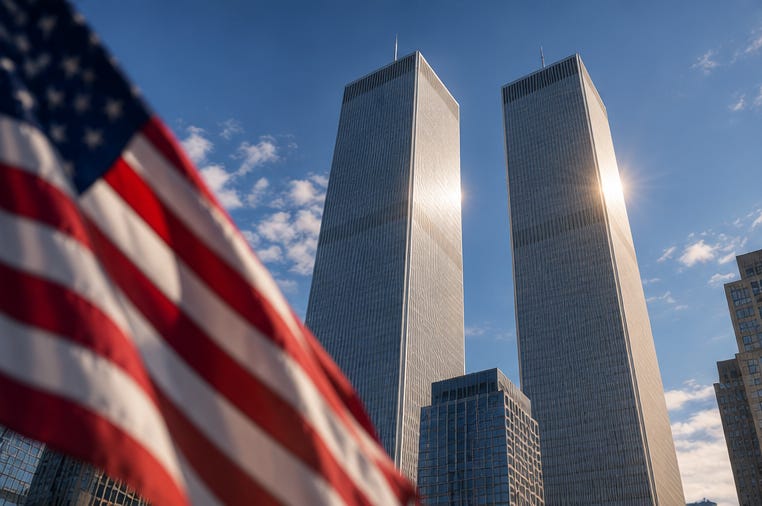
That part matters.
I wasn’t imagining that the private owner of the World Trade Center should simply absorb the cost of turning a national symbol into a national response. The owner would have been fairly compensated. The property would have changed hands.
A stronger owner would have stepped in.
The United States.
Not because I think governments generally make better landlords or real-estate developers. That would be an entirely different argument. In this particular case, the point was precisely that these buildings would no longer have been ordinary real estate.
September 11 had already changed that.
Once the towers were selected for destruction because of what they represented, rebuilding them became capable of representing something too. The rebuilding itself could have been a statement: you succeeded in destroying the buildings, but you failed to determine what would occupy this ground, what would appear on this skyline, or what this country would choose to preserve.
That is a very different response from pretending the attack never happened. The new towers would have carried the attack with them forever. Their very existence would have depended upon it.
They would have looked the same because forgetting wasn’t the goal.
They would have been stronger because learning was.
The Counterfactual
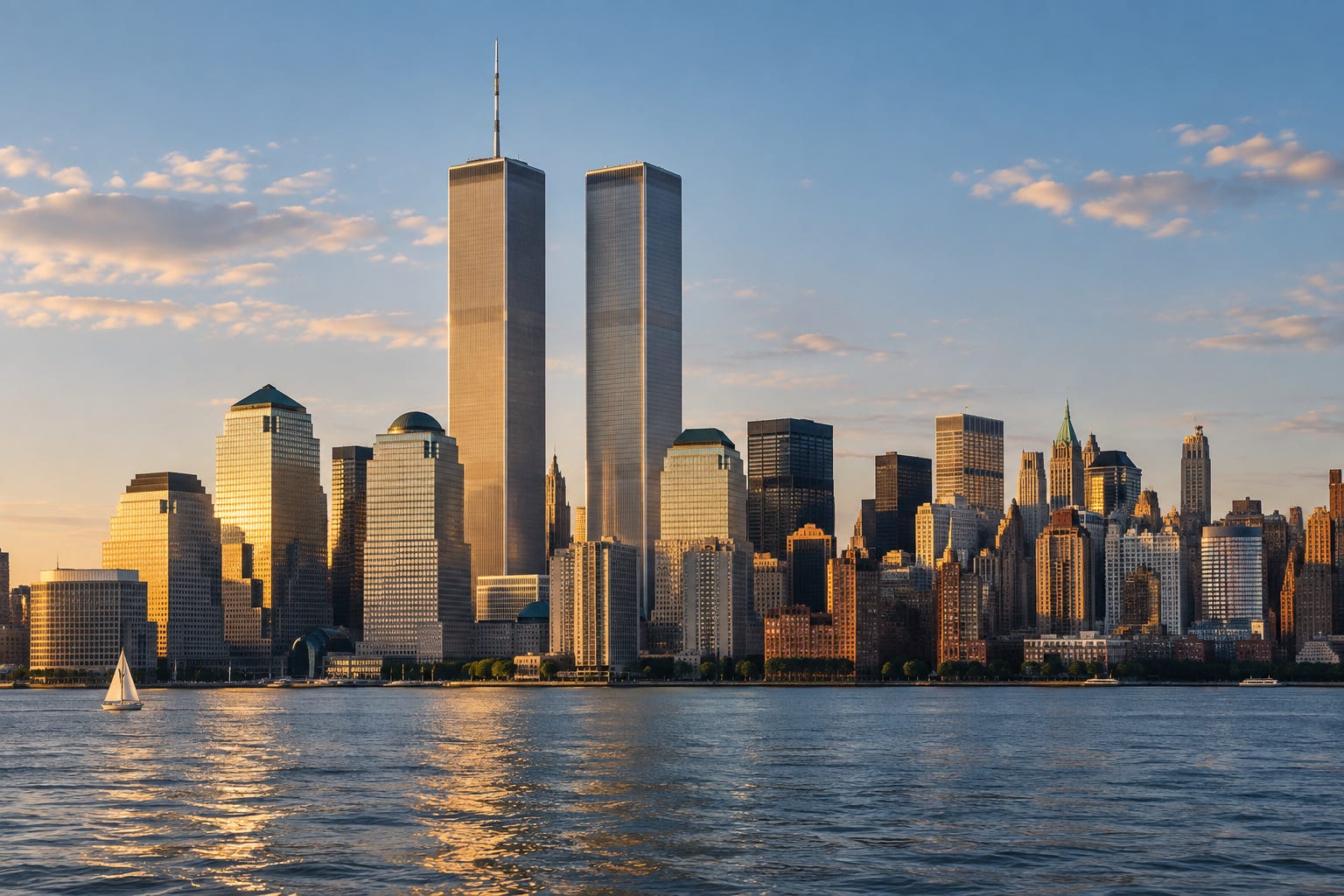
Of course, this is the luxury of a path not taken. I can imagine the towers completed without having to fight through the politics, engineering, cost overruns, competing visions, security concerns, families’ wishes, or thousands of other complications that would have accompanied the actual decision.
Counterfactual history is wonderfully cooperative that way.
But the question that Palmer Luckey’s post brought back wasn’t whether my 2002 proposal could have survived all those realities. It was whether there was something important in the instinct behind it.
We usually talk about resilience as recovery. Something terrible happens, we survive it, and eventually we construct a new normal around the damage.
I was arguing for something more stubborn.
Don’t merely recover from the act.
Deny the act one of its intended consequences.
If someone destroys a bridge, build a better bridge. If someone destroys a monument, restore the monument. And if someone attacks a symbol precisely because they want the world to watch it disappear, there is something extraordinarily powerful about refusing to grant them permanence.
Not because rebuilding somehow undoes the dead. Nothing could.
Not because steel and concrete defeat terrorism. They don’t.
And not because the past can be restored exactly as it was. It can’t.
But because there is a difference between acknowledging what someone did and allowing them to decide what remains afterward.
Twenty-five years later, I don’t know whether rebuilding the Twin Towers would have changed anything beyond the southern tip of Manhattan. Perhaps nothing would have been different. Perhaps the same wars would have been fought, the same policies adopted, the same arguments had, and the same scars accumulated.
Or perhaps one thing would have been different.
Every photograph of the New York skyline for the next century would have contained the answer.
You knocked them down.
We put them back.
🌱 Seed Thought: Some acts cannot be undone. But that doesn’t mean the person who committed them should get the final word on what remains.