


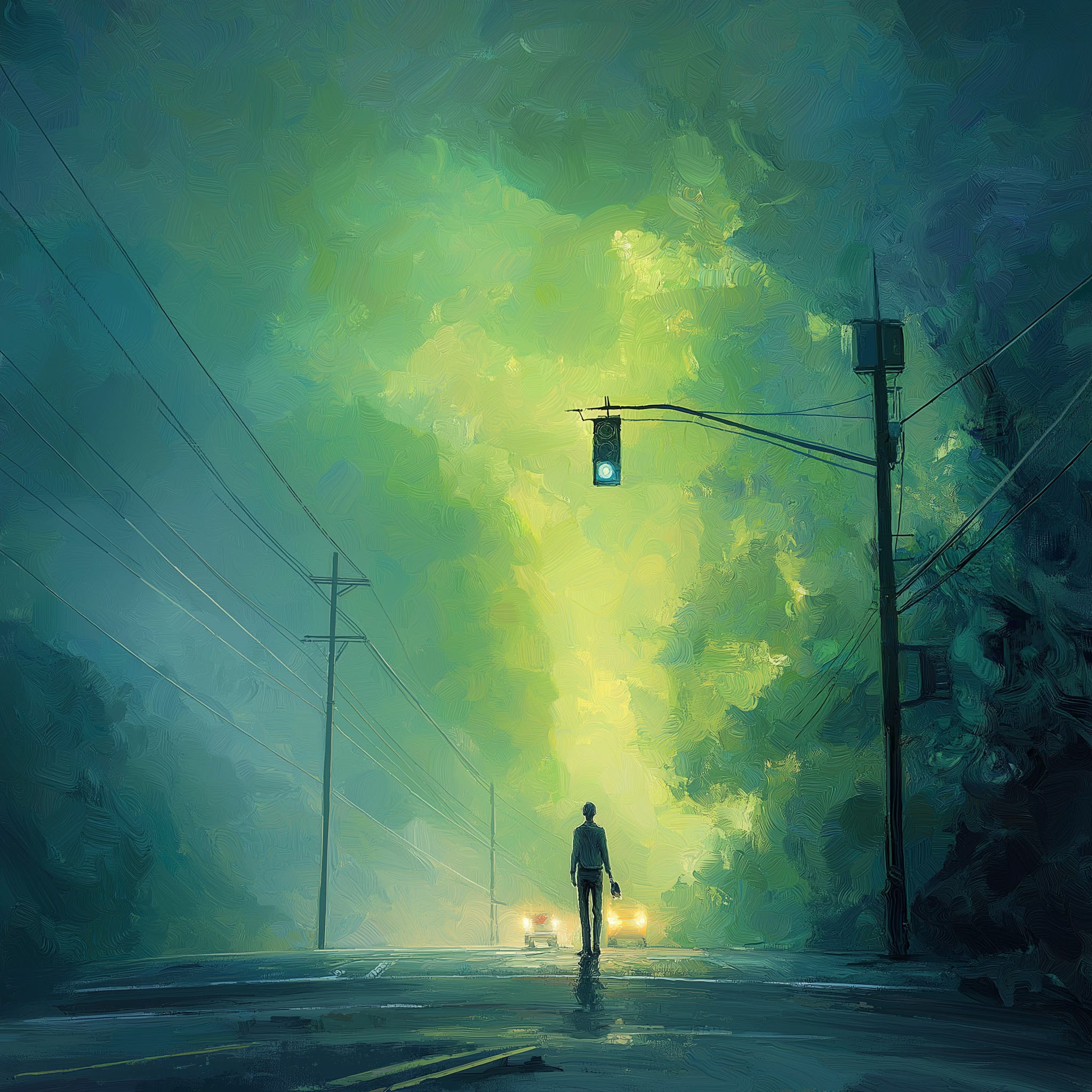
As the year winds itself toward midnight—post-Christmas calm, pre-2026 uncertainty—I find myself tracing back through the dots that brought me here. Steve Jobs once said something striking at Stanford: you can’t connect the dots looking forward; you can only connect them looking backward.
It’s an easy line to quote, harder to live. Because most of the dots don’t look meaningful while you’re standing on them. They’re just fragments—anonymous moments that later glow with unexpected significance.
What’s funny is: this isn’t even the most surprising dot I’ve uncovered. That one needs patience—and maybe the perspective of another year. I’ll save that story for deep into 2026. For now, let’s stay with the humble dot that revealed itself more completely first.
A traffic light.
Green Lights and Tight Pants
Living most of my life in New Jersey, I never questioned the serpentine rhythm of its roads: traffic lights firing off rapid green-yellow-red sequences, three cars through if the stars aligned or one if someone hesitated. Annoying? Sure. But normal. Like pants that shrink gradually—tight becomes “just snug,” snug becomes “fine,” and you forget what breathing feels like.
Florida was always vacation territory for me, like trying on pants at a store when you’re convinced you’re not shopping. Nice climate. Ample parking. Long lights that everyone joked about. But when you aren’t intending to buy, your senses blur. You don’t notice where the seams pinch or where there’s room to stretch.
Then I moved. Settled in. Built routines. And when I returned north, back to Jersey’s flashing impatience, I finally felt the difference. The pants were too tight. Not because quality had vanished—the craftsmanship was still there. Great schools. Green parks—well, for half the year. A certain sharpness that only the Mid-Atlantic seems to brew. But discomfort, when ignored, becomes identity. And when comfort arrives elsewhere, you realize you were holding your breath.
Even stopped at a Florida intersection, fifteen cars deep, I already know: I’ll get through when the light turns. There’s space. There’s flow. Enough time to glance at my phone without feeling like I’m committing a mortal sin against the queue.
Insight at an Intersection

My first instinct was to look for a rule. Was Florida simply lax? Did New Jersey enforce shorter cycles out of spite? Was there a central authority forcing us to wait or sprint?
The truth was humbler: both states tune their lights to local needs. Density, road geometry, vehicle patterns—engineers customizing timing to context. What felt arbitrary was actually applied math living inside a municipal cabinet.
That realization nudged loose another dot—how often we confuse familiarity with necessity. How easy it is to mistake tension for normalcy. How long we tolerate something that just doesn’t fit because we’re afraid to try something else.
The Line Between Calling and Fear
A move is rarely rational in the moment. Fear and instinct speak with similar accents. One voice whispers, stay, this is safe. The other murmurs, go, this is necessary. Confuse the two and you freeze just when movement is needed most.
Jobs’ backward-looking dots map this difference. Only after moving did the signals make sense. Only after breathing out did I realize I’d been holding breath. Only after loosening the belt loop did I realize how tight the pants had become.
This isn’t really about New Jersey or Florida. It could be a job, a partner, a habit, or a belief. The intersection changes, but the metaphor holds. We live through patterns until a return visit—intentional or accidental—reveals the strain we normalized.
The Explorers Weren’t Remembered for Staying Home
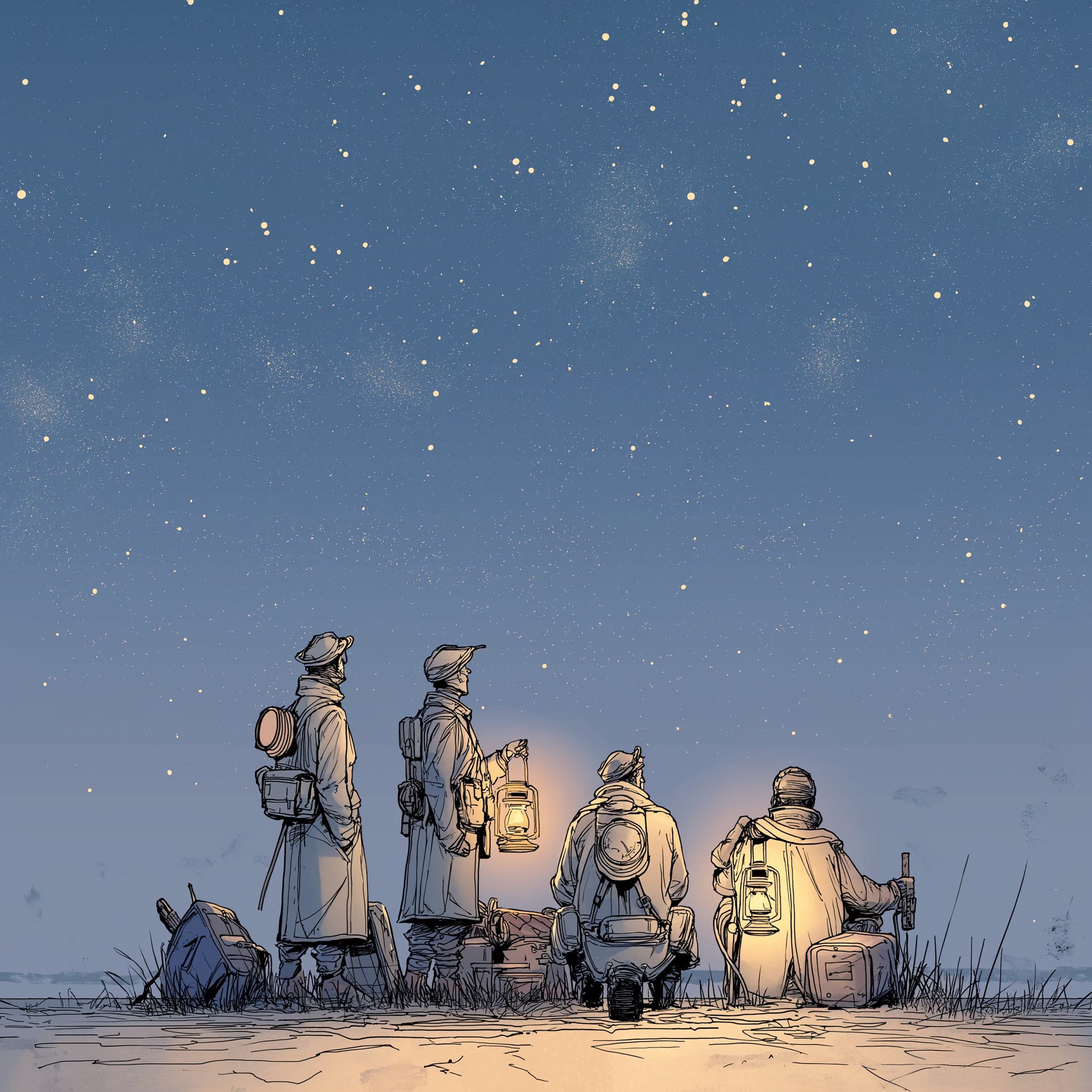
Across centuries, the figures we teach our children—Columbus, Magellan, Shackleton, Lewis and Clark—are remembered because they moved into uncertainty. They left comfort, knowing safety breeds complacency and adventure breeds transformation.
Even in family histories, the names that reverberate tend to be attached to those who relocated farms, founded businesses, or crossed oceans. Their choices cast shadows of opportunity down the lineage tree.
The people remembered are rarely those who kept the lights short and the routines predictable. They’re the ones who risked unpredictability in pursuit of breath, clarity, and possibility.
I didn’t move to Florida because of traffic lights. But now that I’m here, looking backward, that light feels like a dot in the constellation—a signal of how change creeps into the unnoticed until we finally wake up and see it.
Earlier this year I wrote a lyric:
“Move ‘til the gone feels just like alive.”
I think now I understand what that line meant.
🌱Seed Thought: Notice the tightness before it becomes who you are. When life grants you a long red, reflect. When the light turns green, trust your heart—not your fear—and move. The next intersection might just give you room to breathe.

"My shoes are too tight, and I have forgotten how to dance." I could relate to your post. It's often hard to step off the mark and play the new game. I am in the middle of an incalculable timing, and for a few months, I froze. Certainly, places and events influenced that, but I let my normal reason and insist my way through it get fogged and bloodied.
My quiet courage is reviving. I've started to look at what it takes to lay the hero cape down. I still don't want to, I resist. But I think it's ok to lay the cape down for a while, once you've danced.