


Apparently, We’re All Going to Die

Last Friday, in her always entertaining TGIF column in The Free Press, Nellie Bowles opened one of her segments with the observation that we might be starting to see why we have to win at AI.
The preceding week had been a particularly interesting one for those inclined to believe the end of civilization is near. Consider the sequence:
November 12 — Microsoft Outlook, Teams, and Copilot experienced widespread disruptions.
November 13 — The FAA issued a nationwide ground stop following a telecommunications outage.
November 16 — Banking transactions, including some involving Zelle, were disrupted.
November 17 — A highly classified internal communications network used by the National Security Agency went down.
Nellie was stocking up on iodine tablets and beef jerky. Bari Weiss was apparently wondering whether she should stockpile cash.
Meanwhile, over at Pirate Wires, the conversation had turned to AI discovering software vulnerabilities faster than companies could address them, the possibility that Iran was testing our defenses ahead of World War III, and an opportunity to return to the gold standard. Naturally, guns made their way into the discussion as well.
And then there was this little gem that landed in my inbox at 1:59 a.m. on November 18 from the police department in Warren Township, New Jersey, a town I used to live in.
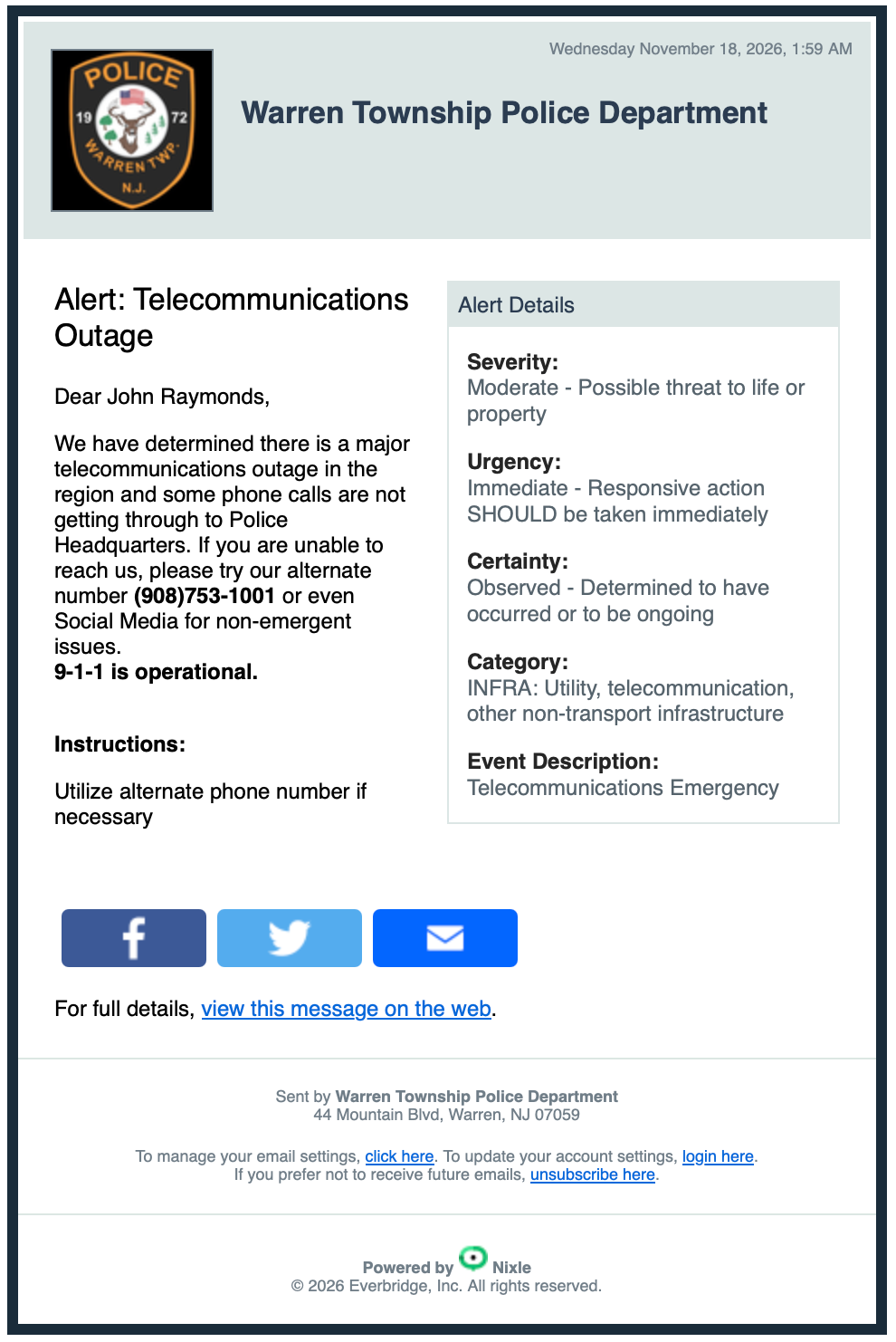
A major regional telecommunications outage was preventing some calls from reaching police headquarters. The good news, apparently, was that 911 was still operational.
Well, shit.
The doomers were right. We were under attack. AI was taking over the world. The banking system was collapsing. The end of times must be near.
Or…
The Same Coin

On July 18, 2025, I wrote a piece called Days When the Universe Breaks. At the time, AI wasn’t even on my radar as a meaningful contributor to the phenomenon I was describing.
July of 2025. A lifetime ago.
Think about what has happened since I wrote that piece. GPT-5 was released. Amazon, Microsoft, and Cloudflare experienced major cloud infrastructure outages in the span of a month. We lived through the longest U.S. government-wide shutdown in history. Nicolás Maduro was captured and brought to the United States. The U.S. and Israel went to war with Iran. Humans traveled around the Moon for the first time in more than half a century. America turned 250. AI began knocking down mathematical problems that had frustrated some of the world’s greatest minds for generations.
That isn’t a recap of a decade. It’s sixteen months.
But back to the piece. In it, I referenced a statistical phenomenon known as clustering. One of the somewhat counterintuitive characteristics of randomness is that it doesn’t look particularly random to the human brain. It comes in clumps, and we have a remarkable propensity to assign meaning to those clumps.
Imagine you have a perfectly fair coin. Flip it enough times and, eventually, you’re likely to get ten heads in a row. The probability of getting ten heads in a particular set of ten consecutive flips is one in 1,024.
Did something about the coin change? Did the world change? Did some mysterious force in the universe align itself in your favor? Is it time to buy a lottery ticket?
Nope. Same coin, doing its same 50/50 thing. And despite what your brain might be screaming at you, the probability of the next flip being heads is still 50%.
Now, if you’re sitting at your kitchen table flipping that coin by hand, it might take a frustratingly long time to experience ten heads in a row. But imagine some crazy engineer builds a machine that can flip the coin, detect the result, and immediately flip it again. Imagine it can do that a thousand times a second.
Suddenly, something that might have taken you an entire afternoon to experience could happen several times before you’ve finished reading this paragraph.
Ten heads in a row. And another ten heads in a row. And another.
Did the coin change? Did the probability change? Is something sinister happening?
No. The coin is just flipping faster.
Of course, the real world is a little more complicated than a coin toss. Our technological systems share dependencies, and failures in one can cause failures in another. What appear to be independent events may not be independent at all. But that doesn’t necessarily mean there is a nefarious actor behind them, either.
Sometimes the dots really are connected. We just might be wrong about what connects them.
The World at Machine Speed
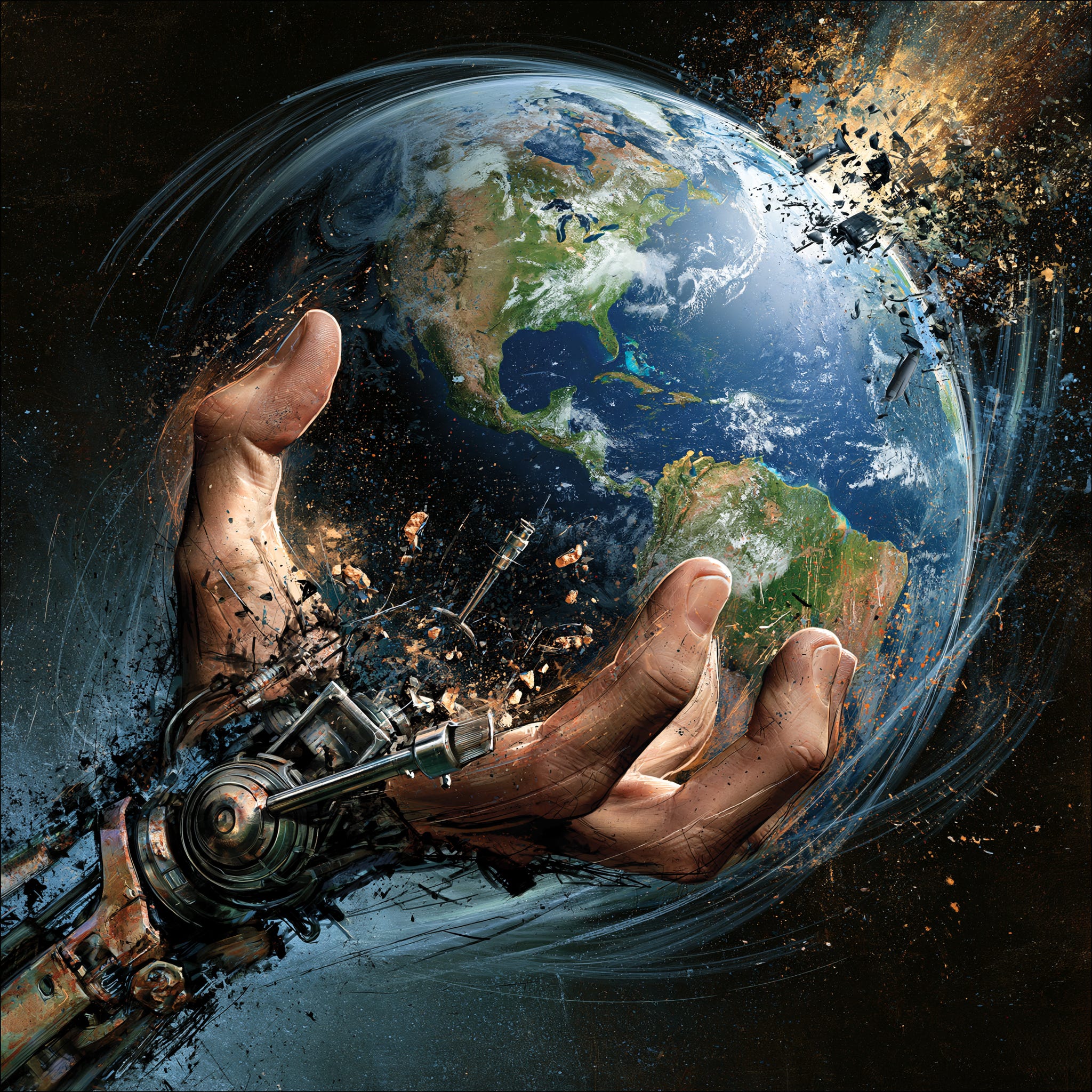
In April of this year, Anthropic announced Project Glasswing, an initiative to use AI to identify vulnerabilities in some of the world’s most critical software. Its Claude Mythos Preview model had discovered, among other things, a vulnerability that had gone unnoticed for 27 years in OpenBSD, an operating system with a particularly strong reputation for security.
By October, Anthropic reported that its partners had identified at least 129,000 verified software vulnerabilities between April and July alone.
Let that sink in for a moment. Some of these vulnerabilities had existed for decades. They were sitting there, quietly waiting to be discovered, while humans went about their business at human speed.
Then we built a better coin-flipping machine.
Last May, an OpenAI model disproved an 80-year-old conjecture in discrete geometry put forward by mathematician Paul Erdős. And just last Friday, an Anthropic mathematician announced that, working with Claude, he believed he had solved the Riemann hypothesis, a mathematical problem dating back to 1859. The proposed proof has already passed independent computerized verification, although the broader mathematical community is still digesting its implications.
We are talking about problems that have outlived the people who originally posed them. And now we are starting to measure progress against some of these problems in weeks rather than generations.
Why would we expect the discovery of vulnerabilities in computer software to be any different?
Here is where things get particularly interesting. Finding a problem and fixing a problem are two very different processes. You can accelerate the discovery of vulnerabilities by orders of magnitude without achieving anywhere near the same acceleration in the safe deployment of fixes.
Imagine having a piece of infrastructure that has been happily doing its thing for twenty years. Now imagine being handed a list of a hundred things that are wrong with it and knowing that the bad guys may soon have access to much the same technology that produced that list.
You have a choice. Do you risk leaving the system vulnerable while you methodically test your upgrades, or do you accelerate the deployment of those upgrades and accept an increased risk of breaking something in the process?
Neither choice comes without risk. And simply choosing not to participate in this new AI-enabled world is no longer a particularly viable third option. Your adversaries get a vote.
The irony is that, for some period of time, making our infrastructure more secure might actually make it less reliable.
That doesn’t mean there aren’t real attacks happening. There are. Nor does it mean that AI is responsible for every one of the outages we experienced this month. So far, no public evidence has established that they were part of a coordinated attack.
But I suspect we are going to see more successful cyberattacks, more failed software upgrades, more infrastructure problems, and more clusters of seemingly extraordinary events as the world attempts to reconcile the speed of its new technologies with the speed of the infrastructure upon which those technologies depend.
Hopefully, our ability to fix things will eventually catch up with our ability to find things that need fixing. Until then, what we perceive as chaos may well become our new normal.
Which brings me to Palmer Luckey, the founder of Oculus and Anduril. At last week’s New York Times DealBook Summit, Andrew Ross Sorkin asked Palmer whether he was a prepper.
Having admitted to owning an underground missile base, Palmer went on to make a considerably more mundane suggestion. People should have at least three days’ worth of water and food and should refill their prescription medications before they actually run out.
He also made the amusing observation that this sort of thing used to be taught to children in middle school. Today, apparently, remembering those lessons qualifies you as a nut.
There is a rather significant difference between preparing for the end of civilization and preparing for the possibility that civilization might be inconvenient for a few days.
You don’t need an underground missile base. You probably don’t need a decade’s supply of beef jerky or enough ammunition to defend a small country. But if your ability to survive comfortably for more than seventy-two hours is predicated on your local supermarket being open, your credit card working, and your pharmacy having access to its computer system, perhaps a little less optimization in your personal life wouldn’t be such a bad thing.
A few extra rolls of toilet paper aren’t necessarily a vote of no confidence in the future of humanity.
🌱 Seed Thought: The world doesn’t have to be coming to an end for it to become considerably more chaotic. Be optimistic about where we’re going, but resilient enough to enjoy the ride.
