
On that flight from St. Louis to Manchester, New Hampshire where Joe Polish turned a quiet trip into an impromptu interview with a few entrepreneurs trapped in the same aluminum tube for a couple of hours. That conversation didn’t stay on the subject of business for long.
In fact, one of Joe’s next questions pushed in the opposite direction:
What matters to you beyond business?
At first glance that might sound like a detour. In reality it’s the same road. Because if you spend enough years building companies, you eventually realize something important:
Understanding business also means understanding what sits outside of it.
Joe framed the question well. People who are not entrepreneurs often have a distorted picture of business owners — greedy operators obsessed with profit.
Yet most of the entrepreneurs I know eventually move in the opposite direction. After building something, they start asking a different question:
What difference can this make beyond the business itself?
Tony Robbins talks about contribution as one of the six human needs. If my memory is right, he also describes it as a circle that expands outward — starting with yourself (like the airline oxygen mask rule), then widening to family, friends, community, and sometimes much further.
Looking back now, the answers I gave Joe on that flight all lived somewhere inside that expanding circle.
Education: A Thread That Leads Back to MIT
Education has always been the most natural place for that circle to expand for me.
I graduated from MIT in 1986 with a degree in electrical engineering. Years later our family created the John Raymonds (1986) Scholarship as a way to give back while staying connected to the institution that shaped so much of my early thinking.
When the fund was first established in 2005, I didn’t fully appreciate how long the ripple effects of something like that could last.
Today the Raymonds Scholarship has been awarded 21 times to six recipients, with all but one receiving support for their entire four-year undergraduate experience — something MIT prefers whenever possible.
The scale of financial aid at MIT has evolved significantly over the years as well.
Today roughly 58% of MIT undergraduates receive need-based scholarships, and the Institute has expanded access dramatically in recent years, including policies that allow many families earning under $200,000 to attend tuition-free.
Scholarships funded by alumni and donors play a meaningful role in that system. MIT’s endowment itself is composed of thousands of individual funds created by alumni, families, and organizations, each helping support future students.
When you think about it, it’s a remarkable idea.
A decision made decades ago can quietly help students you will never meet.
When Education Takes Unexpected Forms

Education doesn’t always follow traditional paths.
Years ago I became involved in the revival effort for Reading Rainbow, the legendary children’s literacy program hosted by LeVar Burton. For an entire generation of kids, Reading Rainbow made books feel like adventures waiting to happen.
The show ran for twenty-six years on PBS, but by the time tablets and smartphones took over childhood attention spans, the world had changed. The question became how to bring that same sense of discovery into a digital environment.
The effort to revive Reading Rainbow as an interactive digital experience was part of that transition. Like many ambitious ideas, the journey was complicated and the outcome imperfect, but the intention was clear: keep the magic of reading alive for a new generation growing up in a completely different technological landscape.
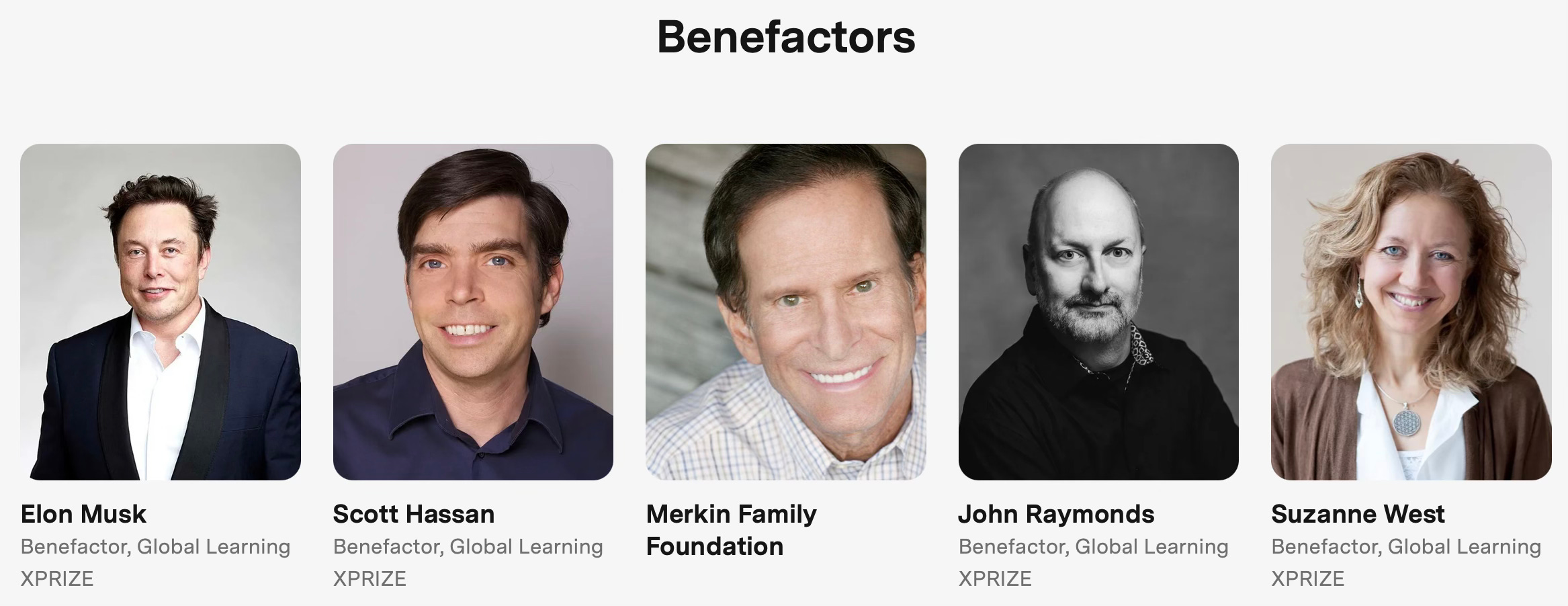
Another path into education came through a much more unexpected direction: the XPRIZE Foundation.
I first met Peter Diamandis almost by accident while supporting a charity event that included a Zero-G flight with people like Tim Ferriss, James Cameron, and Elon Musk. The flight itself was unforgettable, but the real surprise was learning about Peter’s vision for using prize competitions to tackle some of the world’s hardest problems.
One of those problems was education.
The Global Learning XPRIZE was designed to answer a difficult question: could technology allow children in remote parts of the world — places without schools or teachers — to teach themselves basic reading, writing, and arithmetic?
The challenge invited teams from around the world to build open-source learning software capable of doing exactly that.
Years later the competition concluded successfully, with winning teams demonstrating that children in remote villages could indeed make significant learning gains using tablet-based educational software.
It was a powerful reminder of something simple but profound: Technology scales.
Schools and teachers, unfortunately, often do not.
For children growing up without access to education at all, the difference can be life-changing.
Sometimes the Lesson Is Simply Hope

Not all educational efforts look like scholarships or technology prizes.
Sometimes they look like a man in a tie-dye shirt.
In 2004 I met Rupert Boneham, who many people recognize from the television show Survivor. What many don’t realize is that Rupert has spent much of his life working with disadvantaged kids through the organization Rupert’s Kids.
The mission is straightforward: help children who are struggling — often because of poverty, unstable homes, or difficult circumstances — discover that they are capable of more than the world around them might suggest.
The programs range from mentoring to educational activities and life experiences designed to help kids build confidence and direction.
It isn’t education in the classroom sense.
But sometimes the most important lesson a child can learn is simply that someone believes in them.
A Small Disclaimer About Contribution

Before this list of causes gets misinterpreted, there is something worth clarifying.
If you look closely, the list of organizations and efforts I’ve supported over the years is not very long.
That’s intentional.
For me, contribution has never been about writing checks to causes I barely understand. Every effort mentioned here began with a personal connection — a person I met, a story I experienced directly, or an institution that played a meaningful role in my life — and has gone forward for years.
Without that connection the act feels hollow.
So if there is one takeaway from this part of the story, it’s that contribution doesn’t have to be broad to matter. Sometimes it’s more meaningful when it is focused.
And just to be clear — reading this article and reaching out asking for support will not work.
Not because the causes aren’t worthy.
But because the connection isn’t there.
The Unexpected Joy of Mentorship

There is one final form of contribution that surprised me as my career progressed.
Mentorship.
After decades of building businesses, navigating both successes and failures, and experiencing more volatility than any business plan ever predicts, the most rewarding moments increasingly come from helping someone earlier in their journey.
Not because you have all the answers.
But because sometimes you have just enough scars to help someone avoid one.
That kind of contribution doesn’t require a foundation, a scholarship fund, or a global prize.
Sometimes it simply requires a conversation.
🌱 Seed Thought: Success is often measured by what you build. But eventually a better question appears: What continues to grow long after the business itself is finished?